
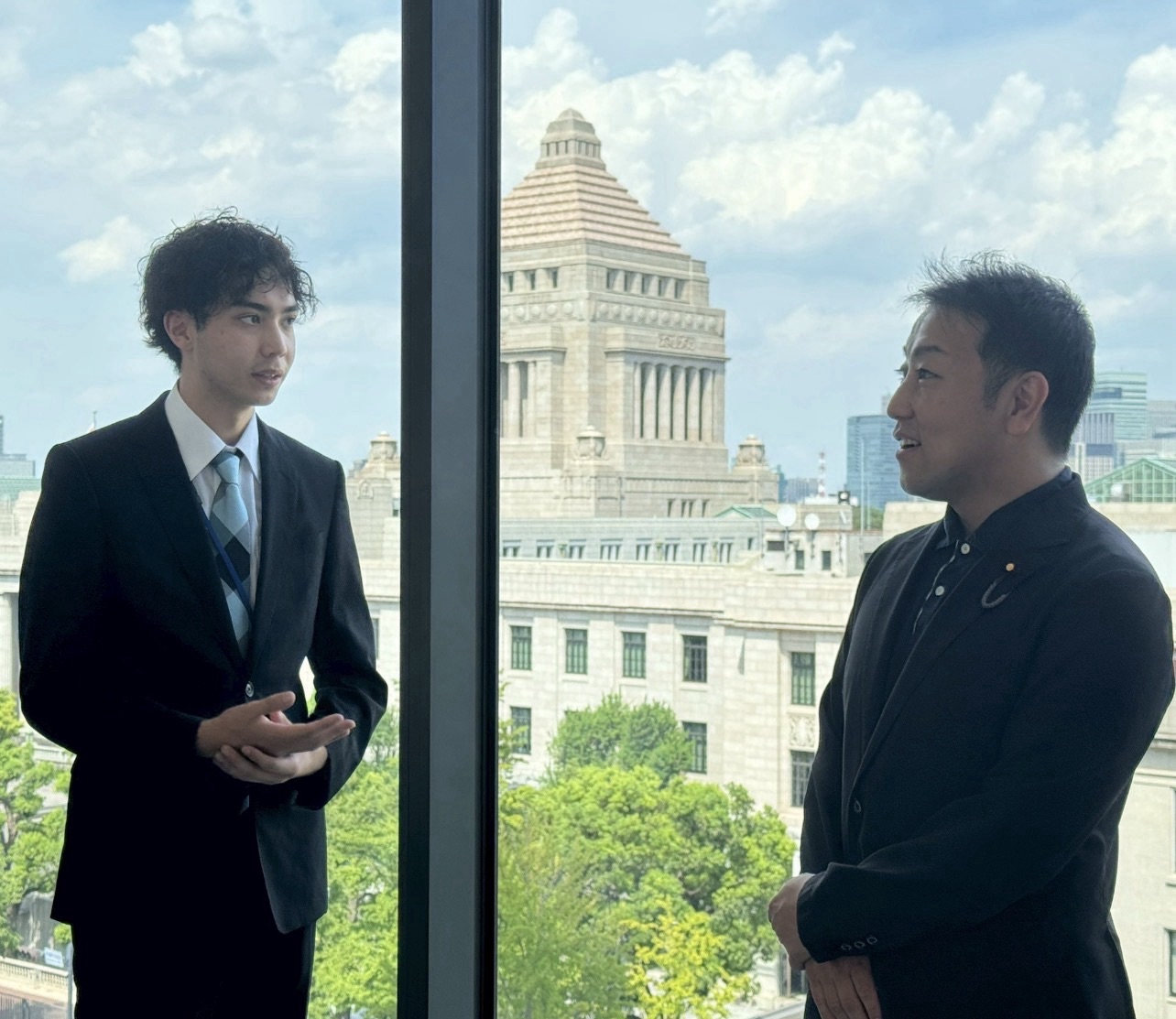
From summer 2025 to early 2026, I worked for a member of the Japanese Diet. During that time, I saw a side of politics that isn’t often visible from the outside. A side that was defined by consistency, routine, and quiet coordination. This article reflects on that experience from a personal perspective. Rather than focusing on policy or ideology or endorsing any particular political position, I want to explore both what I observed and the kinds of work I was involved in, and how these shaped my understanding of politics in Japan. To do this, I’ve divided my experience into four parts: beginning as an intern, visiting the Diet, becoming a staff member, and how my final few weeks in the job unfolded.
I worked under Kazuma Nakatani, who previously served as a secretary to Naoto Kan, a former Prime Minister of Japan, and had been designated as the “Next Digital Minister” within his party, reflecting his focus on digital policy.
Part 1: Interning in the heat
My role in Kazuma Nakatani’s office began as a two-month unpaid internship. During this time, I worked not only with him, but also alongside other local politicians, including a member of the Kanagawa Prefectural Assembly and a city council member.
As I live quite far from his constituency, I would wake up at 5 a.m. three or four times a week to begin my journey. Each morning, we arrived at a different train station to hand out leaflets for around two hours. It was August, and the intensity of the Japanese summer heat was difficult to ignore. I relied on a cap, salt sweets, and neck coolers just to stay functional.

What I did not anticipate was how many people were actually willing to accept a leaflet, if it was done properly. It was all up to me to catch their interest. Before starting, I had assumed most people would walk past, the same way I usually would. In Japan, it often feels like the norm to ignore these interactions. However, I quickly realised that the outcome depended heavily on how I approached it. Smiling, making eye contact, and clearly calling out the full name of the politician I was representing made a noticeable difference. What often goes unnoticed is just how much energy this kind of work requires. It is not passive. It demands constant enthusiasm, even in exhausting conditions. If you visit Japan, you will often see people handing out tissue packs with advertisements at train stations, which is a method that works because people are more likely to accept something free. Even then, many still walk past. After spending days handing out leaflets myself, I began to understand how that feels: the quiet disappointment of being ignored, and the small but genuine satisfaction when someone smiles and accepts one.
Another major part of my work was door-to-door canvassing. This involved going around different districts within Nakatani’s constituency and engaging directly with residents. In a typical session, I would visit around 90 to 100 households, aiming to both understand local concerns and build trust. The physical demands were intense. We would step out of the car into 35-degree heat and humidity, equipped with the same essentials: salt sweets, cooling gear, towels, and hand fans. For hours at a time, I moved from house to house, often feeling on the edge of heat stroke. To navigate, I created my own maps by cutting and taping together printed sections of neighbourhood layouts, which I carried with me throughout the day.
What stayed with me most, however, was the importance of listening. More than delivering a message, it was about making the other person feel heard. Showing that I wasn’t there simply to promote a politician, but to engage genuinely, made a significant difference. It sounds simple, but allowing people to speak fully, and responding thoughtfully, was often what opened the door to meaningful conversation. I began to see these interactions less as one-sided communication, and more as a kind of exchange, like a game of catch, where both sides needed to participate for it to work.
Finally, I had the opportunity to give a few short speeches alongside a member of the prefectural assembly. Speaking for a few minutes at a time, I explained how I became interested in politics and why I chose to pursue the internship.
At first, I felt quite anxious. However, as I continued, I realised that people were simply going about their day, listening in passing rather than focusing on every word. In a way, this made it easier. Once I let go of the pressure to speak perfectly, I found myself becoming more confident and natural in how I spoke.

Other activities included office work such as folding leaflets, creating signs, joining important meetings and assisting with the organisation of contact lists for outreach.
Part 2: The Diet
During my internship, I had the opportunity to tour the National Diet, as well as various prefectural assemblies. Through this, I was able to see spaces such as the chamber of the House of Representatives and areas used during imperial visits. Seeing all of these iconic places with my naked eyes was surreal.

What surprised me was how frequently these visits are organised by politicians’ offices. Not just for interns like me, but for primary school children. Staff coordinate with local schools to arrange guided tours for students, introducing them to the workings of government from a young age. I was given the opportunity to help with one of these visits in early 2026, although I was ultimately unable to take part, as I will mention why later.
Even in such a formal setting, there were elements that felt uniquely Japanese. The Diet building, despite being the centre of national politics, was not free from the presence of souvenirs and stylised, almost playful imagery. At the time, Shigeru Ishiba was Prime Minister, and an animated version of his face appeared on many of the snacks and gifts sold there. One staff member mentioned that Ishiba-themed merchandise had become particularly popular, perhaps even more so than that of Shinzo Abe. Her explanation was simple: people might initially laugh and say they would not buy it, but the design’s charm would eventually win them over.
The visit also gave me brief glimpses of political life beyond structured settings. During my time there, I passed by several well-known figures, including Yoshimasa Hayashi, who was serving as Chief Cabinet Secretary at the time.
I also had the opportunity to visit a prefectural assembly, which gave me a further perspective on how politics operates at a more local level. I had the chance to observe a speech given by the local city council member I also worked for, offering another perspective on how political communication is carried out.
Part 3: Working as a staff member
Towards the end of my internship, I was offered to continue on as a gakusei-staff, meaning a staff member who is still a student. During this period, I became more involved in organising events and supporting local outreach. One of the main things I worked on was helping to organise a “Talk to Nakatani” event. As part of this, I helped set up the venue we had borrowed, arranging seating and preparing posters, as members of the public came to take part in a Q&A session with Kazuma Nakatani. Beyond that, my role expanded into more public-facing activities. I represented Nakatani at a local annual art exhibition and also accompanied him to a local omatsuri (festival), where I observed how he engaged with the community in a more informal setting. Another part of my work involved contacting local businesses, such as a nearby hot spring bath, to request permission to take photos for use on his social media. This was aimed at promoting local businesses and strengthening connections within the community.

For one event, I represented my MP at a yearly gathering held at a local primary school. At the beginning, the “important” attendees were introduced one by one. Each person would stand, turn to face the audience, offer a short greeting, and bow. Watching this, I was reminded of similar moments from my own time in primary school, such as during sports days and school fairs where I had seen the same formalities take place. Experiencing it now from the other side made it feel both familiar and slightly different. Seated next to the main representative from my office was Keisuke Suzuki, the opposition candidate for the district. I had already seen his face on posters across the area since starting my internship. He left after a few performances, as did we shortly after. What became clear to me through moments like this was how important simple appearances are in politics. These visits are, in many ways, gestures. They are ways of showing presence, interest, and connection with the local community and the events they organise.

At another point, I helped prepare Kazuma Nakatani’s bicycle, attaching posters to each side before it was used around the area. It was a small task, but it reflected something broader. Kazuma would ride on his bike across different streets, waving and calling out to people he walked past. What stood out to me wasn’t any particular political stance, but the consistency of the work behind it. Engaging with the public involved a constant rotation of small, often repetitive activities, all contributing to a larger presence.
Part 4: The final weeks

In the spring of this year, I travelled to England to visit my family. The morning after I arrived, the first thing I saw when I opened Instagram was a post from Kazuma Nakatani, showing a new identification card with a party logo I did not recognise. I soon realised that his party had merged with another, forming a new opposition group. At first, I was surprised that such a significant political shift had happened while I was still involved as a staff member. But in reality, it reflected something I had already begun to notice: politics is constantly changing, and being part of it only made those changes feel more immediate and personal.
Not long after, a general election was suddenly announced by the Prime Minister. Being in England, I had little opportunity to take part, and instead found myself watching everything unfold from a distance. I missed the chance to help organise a speaking event involving my MP and the party leader, a former Prime Minister, which would have been a great experience. This is the same reason I missed out on helping with the Diet tour. As the weeks passed, election day arrived, coinciding with a short trip I had planned across Europe. The timing unfolded in a way I could not have predicted:
- Day 1: Belgium — election day
- Day 2: Luxembourg — the day Nakatani lost his seat
- Day 3: Germany (returning via Luxembourg) — the day I found out I had lost my role
I was in Luxembourg when I learned that Nakatani had lost the election. Just an hour before boarding my flight, I found out that his office would be closing, and that the staff, myself included, would no longer have a position. It was the first time I had felt the effects of politics so directly. Being in a country such as Luxembourg, one of the smallest countries in Europe, while everything unfolded back in Japan created a strange sense of distance and disconnection. The disbelief of this happening during the 24 hours I was there made me feel so far removed from it all. It was a moment that was difficult to fully process.
I had assumed that he would retain his seat. Given his visibility and presence in the area, it seemed unlikely that things would change so abruptly. However, the broader political climate had shifted. The strength of the Liberal Democratic Party, alongside wider changes across opposition groups, resulted in a decisive outcome.
The end of my time in his office was sudden. More than anything, it felt like losing a place I had come to value. Not due to political alignment, but because of the experience itself. It was something I had become genuinely interested in, both through my studies and through being part of it in practice. Since then, I have met and remained in contact with Kazuma Nakatani on occasion. One of the most important things I took from this experience was the value of building and maintaining relationships.
Looking back, what I gained from this experience was not a fixed political viewpoint, but a clearer understanding of how politics functions from the inside. From early mornings handing out leaflets in the summer heat, to conversations with residents, to observing the quieter routines behind public appearances, I came to understand that politics is built on consistency more than anything else. Being part of that process changed how I see things. Although my time there ended unexpectedly, the perspective it gave me has stayed with me.


Leave a Reply