
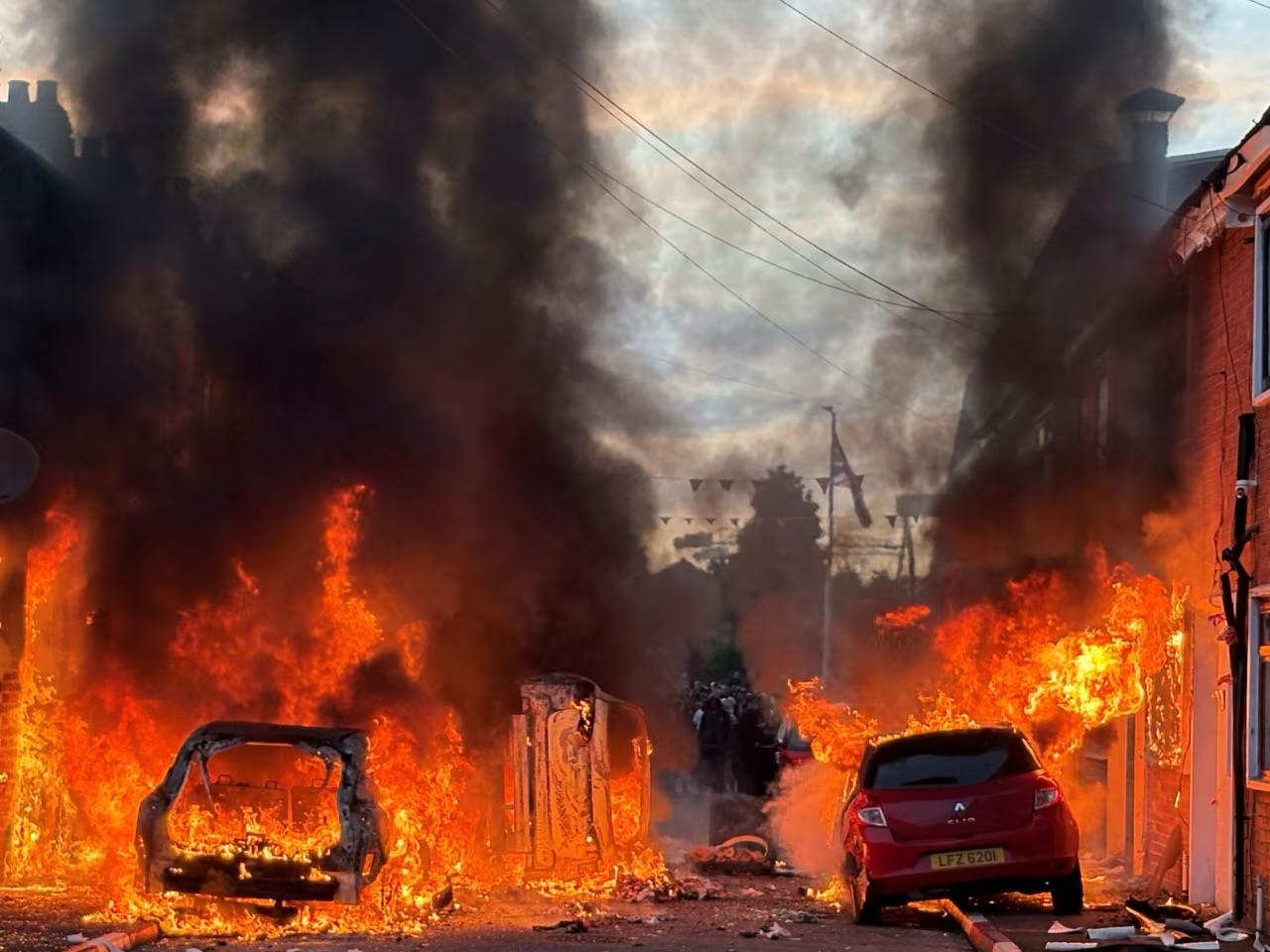
Just as the United Kingdom was reeling the murder of Henry Nowak, the controversy surrounding his treatment by police, and the racial debates that followed, another serious incident occurred in Northern Ireland. On the 8th of June, footage emerged showing a Sudanese migrant attacking a Northern Irish man. ¹
The video, which circulated widely online, showed the attacker on top of the victim, repeatedly slashing at him in what appears to be an attempted beheading. According to reports, the suspect had travelled from Sudan, via Paris and Dublin, before arriving in Northern Ireland by bus. In the days that followed, riots broke out in parts of Belfast. Homes occupied by migrants were targeted, with windows smashed and doors damaged. Several properties were set on fire, while cars and buses were also burned. Those who had no connection to the attack itself were targeted. The unrest deepened tensions between communities and sparked fierce debate across social media and the political spectrum.
I do not seek to justify either the attack or the riots in this article. Instead, I hope to shed light on some of the difficult questions and inconsistencies that have emerged in their aftermath. Why do some people blame migrants as a whole for the actions of one individual? Why do others appear more focused on condemning the riots than discussing the stabbing that triggered them? Does race influence how these incidents are perceived and reported? And why do some violent crimes spark widespread unrest while others do not? If communities are to move forward, understanding the different reactions to such events may be just as important as condemning the violence itself.
Let us first address what I would call “selective outrage”. Many people seem more interested in condemning one wrong than all wrongs. This pattern can also be seen in discussions surrounding Henry Nowak. Some commentators have focused heavily on explaining why his case differs from those involving non-white people, despite previously expressing strong support for cases such as George Floyd’s. Others passionately discuss Nowak’s case while dismissing Floyd as merely a drug user or criticising Black Lives Matter as being too political for public spaces such as sports and television. In both instances, outrage appears to be influenced by political loyalties rather than consistent principles.
The attack in Northern Ireland itself was horrific. A man was left with life-changing injuries after a visible attempted murder that shocked people across the nation. Yet the reaction quickly split along political lines. Some right leaning commentators focused almost exclusively on the alleged attacker and his immigration status, while appearing reluctant to condemn the attacks on innocent migrants that followed. Meanwhile, some voices on the left appeared far more focused on condemning the riots than discussing the stabbing that had triggered public outrage in the first place. Both responses risk missing the bigger picture.
The alleged attacker is responsible for his own actions. His nationality, immigration status, or ethnic background do not transfer that responsibility onto thousands of innocent people who share those characteristics. Everybody knows this. The migrants whose homes were attacked in Belfast did not stab anyone. Some had fled war, persecution, or hardship themselves. Reports described families being evacuated from burning homes and forced to flee for safety. Whatever anger people felt about the stabbing, those families were not responsible for it.
At the same time, it is understandable that many people became frustrated when they felt discussion of the stabbing was being overshadowed by discussion of the riots. If society is willing to discuss violence honestly, it must be willing to discuss all violence honestly, regardless of who commits it.
But why do some crimes spark riots while others do not? Northern Ireland and the whole of the UK has seen murders and crimes committed by people born in the UK who are of white heritage, without triggering widespread unrest. If the concern is genuinely public safety, why are reactions often so different depending on the identity of the offender? We have yet to see riots or even widespread protests for the murder of Natalie McNally, a pregnant woman, who was murdered by her partner, Stephen McCullagh, in 2022. ² He was sentenced a few days before this event, but no riots associated with it. How about when news broke out of a neo-Nazi teenager’ attempt to behead a Kurdish barber in Bristol, England. ³ Few people argued that all white Britons shared responsibility for the attack. Most recognised that the blame belonged to the individual offender and the extremist ideology that motivated her. The same principle should apply regardless of the background of the perpetrator. If we reject collective blame in one case, we should reject it in all cases.
Likewise, if the slogan is “protect our women and children”, does that concern extend to migrant women and children whose homes were set on fire? Principles only have meaning when they are applied consistently. All innocent people should deserve protection equally.
Perhaps the most important lesson from Belfast is that outrage can be both justified and misplaced at the same time. People were right to be horrified by the stabbing, but directing that anger at unrelated families is behaviour that we should condemn. Likewise, people were right to condemn the riots, but should not ignore the attack that sparked them. A healthy society should be capable of condemning both. Acknowledging one should never require excusing the other. Nor should it lead us to assume that anyone who focuses on one injustice must therefore support another. If public debate is to move forward, it must do so with consistency, empathy, and a willingness to apply the same principles regardless of who the victims or perpetrators happen to be.



Leave a Reply