
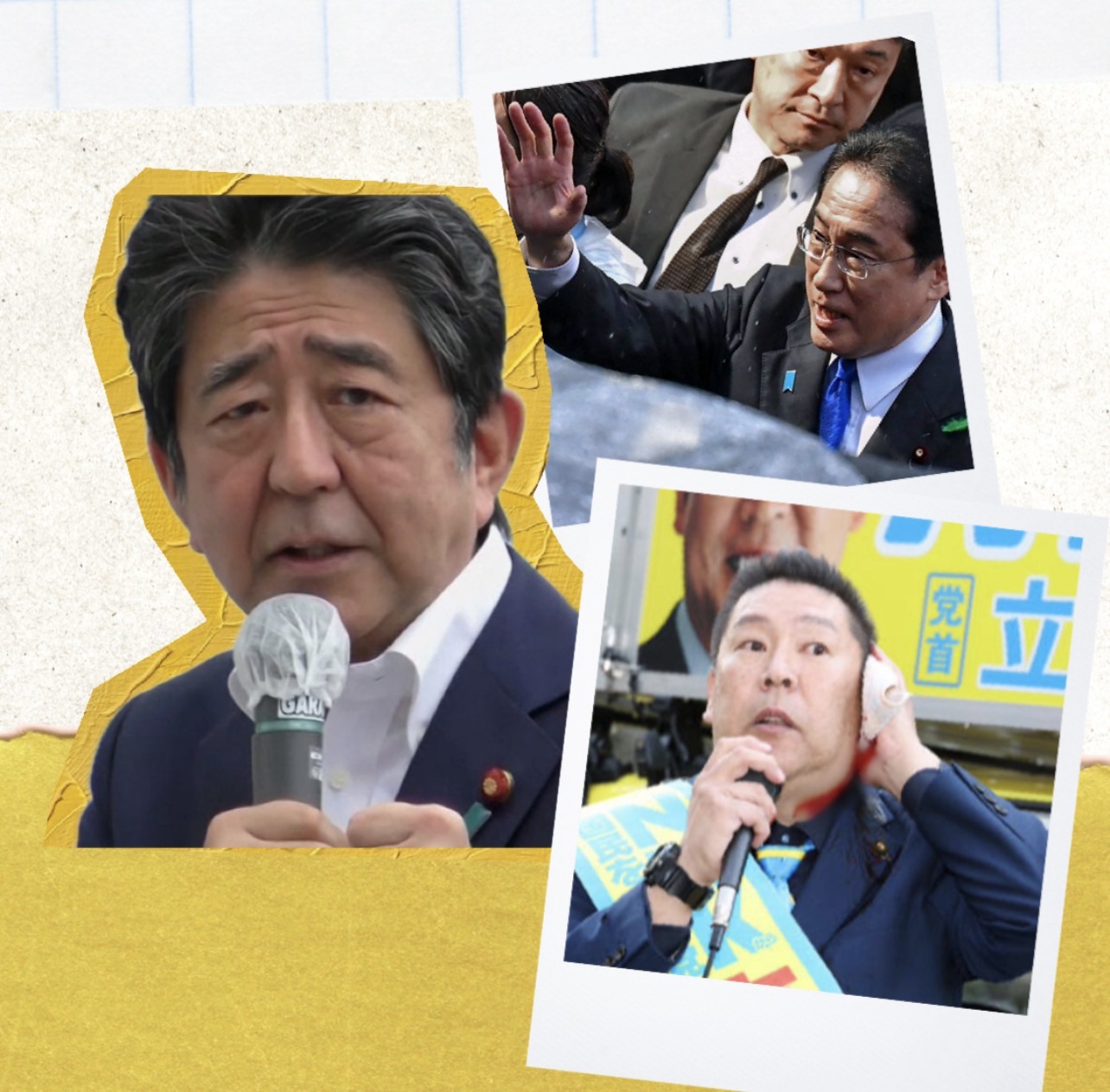
Heiwa boke, translated as “peace-fool” or “peace-dazed”, describes the common mindset of becoming too used to the peacefulness and stability of Japan, and in the process becoming vulnerable to potential dangers and threats.
For decades, Japan has been viewed both domestically and internationally as one of the safest countries in the world. Yet within the span of only a few years, the country witnessed the assassination of a former prime minister, an attack on a sitting prime minister, and another violent assault on a high-profile politician during a public campaign event. Rather than isolated incidents, these attacks may reveal something deeper about modern Japan: a political culture still psychologically unprepared for violence.
Part 1: The Rise of Political Violence in Japan, and the Patterns Behind It
On the evening of March 14th, 2025, Takashi Tachibana stepped down from his campaign vehicle in Tokyo’s Kasumigaseki district. With the Chiba gubernatorial election only days away, the controversial leader of the anti-NHK party was greeting supporters before beginning his speech. One by one, members of the public approached him for photographs and handshakes. They bowed politely, exchanged smiles, and briefly spoke before moving aside for the next person in line. Then came one particular man.
Witnesses later noted that he had been calmly queueing beforehand, at one point even gesturing casually towards staff members as if nothing was unusual. Standing face-to-face with Tachibana, the man nodded slightly and appeared to reach forward for a handshake. Instead, he suddenly pulled a weapon from his pocket and swung it towards the politician’s head, slashing his ear with a small axe. 1

The moment Takashi Tachibana was attacked with an axe
As Tachibana pressed cloth against his bleeding ear beside the campaign van, the suspect stood silently while bystanders restrained him. What stood out most in the footage, however, was not only the attack itself, but the behaviour of those surrounding it. The suspect was initially restrained not by security personnel, but by a member of the public who moments earlier had been shaking Tachibana’s hand in the same queue. Meanwhile, nearby police officers appeared strangely passive, hovering around the scene almost as if they had not fully processed what had just happened.
The incident immediately reminded many people of another shocking moment that unfolded less than three years earlier. In July 2022, former Prime Minister Shinzo Abe was assassinated while giving a speech in Nara. Then, in 2023, another attack targeted then-Prime Minister Fumio Kishida after a pipe bomb was thrown towards him during a campaign event in Wakayama. Three separate attacks. Three isolated male perpetrators. Three major security failures. At what point does a coincidence become a pattern?
Part 2: The Assassination of Shinzo Abe

The assassination of Abe in 2022 remains one of the most shocking events in modern Japanese political history. Abe was not simply a former leader, he was Japan’s longest-serving prime minister and one of the country’s most internationally recognisable political figures of the 21st century. Yet despite this, Tetsuya Yamagami was able to calmly approach him from behind with a homemade firearm while security failed to intervene before the shots were fired. 2
For many outside Japan, the footage itself felt surreal. Had world leaders who served during the same period as Abe, such as Barack Obama or David Cameron, been giving public speeches after leaving office, few would expect them to stand so exposed to the crowd with such limited visible protection. Abe’s assassination shocked many observers precisely because the level of security surrounding a former Japanese prime minister appeared unusually relaxed by international standards.
Equally striking was the reaction of the crowd. Many bystanders appeared confused rather than terrified, hesitating instead of immediately fleeing after what sounded unmistakably like gunshots. Some simply turned around slowly in disbelief. The incident exposed something deeper than a security failure alone. It revealed how politically unprepared modern Japan appeared to be for sudden public violence.
Initially, some assumed the assassination was politically ideological or connected to Abe’s policies. Instead, the motive was intensely personal. Yamagami blamed Abe for his links to the Unification Church, which he believed had destroyed his family through excessive donations made by his mother. Reports surrounding Yamagami’s background painted the picture of a deeply isolated man. His family reportedly experienced severe financial hardship and instability, while suicides involving close relatives added further tragedy to his upbringing. Former classmates described him as quiet and withdrawn. In his graduation yearbook, Yamagami reportedly wrote that he did not know what he wanted to become in the future. 3 It was long-term alienation and resentment that shaped him, not political anger.

Following Abe’s assassination, one would assume that Japanese political security would drastically tighten. Instead, less than a year later, another major attack occurred.
Part 3: From Shinzo Abe to Fumio Kishida
In April 2023, then-Prime Minister Fumio Kishida was giving a campaign speech in Wakayama when a pipe bomb was thrown towards him from within the crowd. Kishida escaped safely after being rushed away by security, while the suspect, Ryuji Kimura, was arrested shortly afterwards.

Again, questions emerged immediately. How had somebody carrying an explosive device managed to get so close to the leader of Japan only months after Abe’s assassination? Why did security still appear reactive rather than preventative? Kimura’s motive once again turned out to be highly personal rather than ideological. Reports stated that he held resentment over election laws after being unable to run as a candidate due to age restrictions. Kishida himself was not directly responsible for the situation.
At the time, however, Kishida was already deeply unpopular among sections of the Japanese public, following issues such as tax increases and criticism over the controversial state funeral held for Abe using public funds, as well as alongside growing scrutiny surrounding the Liberal Democratic Party’s ties to the Unification Church. Because of this, many people initially assumed the attack must have been politically motivated in a broader ideological sense. Yet once again, the reality appeared far more personal and psychologically complicated. 4

The similarities between Kimura and Yamagami were difficult to ignore. Former classmates described Kimura as quiet and increasingly withdrawn during adolescence. One testimony claimed his personality changed dramatically during secondary school, particularly after conflict involving a teacher who reminded him of his father, with whom he reportedly had a troubled relationship. Just like Yamagami, Kimura appeared to fit the profile of a socially isolated man carrying deep personal frustration. 5
Part 4: The Attack on Takashi Tachibana
Then came March 2025. The attack on Takashi Tachibana once again followed a disturbingly similar structure. The suspect, Shion Miyanishi, allegedly waited patiently among ordinary supporters before suddenly attacking his target at close range.
According to reports, Miyanishi later claimed he targeted Tachibana due to the politician’s alleged involvement in the Hyogo whistleblower scandal, which was linked to the suicide of another politician. He reportedly stated that Tachibana was “the type of person to lead others into suicide.” 6
Whether this was the sole motivation remains unclear. The case once again felt strangely personal and indirect rather than conventionally ideological. The idea that somebody would attempt murder over a scandal involving a politician in another prefecture naturally led many observers to question whether deeper motives existed beneath the explanation given publicly.
Once again, similarities between the perpetrators became impossible to ignore.
All three men were socially isolated. All three reportedly struggled with direction or stability in life. All three targeted major political figures in public settings. All three relied on Japan’s unusually relaxed political security environment to get dangerously close to their targets.

A comparison of Tetsuya Yamagami and Shion Miyanishi’s clothing during their respective attacks
Even visually, internet users noted striking similarities between Yamagami and Miyanishi during their respective attacks, particularly their clothing choices. Miyanishi’s dark green top and brown trousers resembled the outfit worn by Yamagami during Abe’s assassination closely enough that some online began speculating about imitation.
While clothing alone proves nothing, the comparison reflected a wider concern already growing since 2022: the idolisation of Yamagami online.
Part 5: The Cultural Response to Yagami
One of the most uncomfortable aspects of Abe’s assassination was the reaction that followed afterwards online.
Although most condemned Yamagami as a murderer, others treated him almost like a tragic anti-hero. Sympathy towards him spread across Japanese social media due to the details of his upbringing and family circumstances. Reports emerged that his family had received over one million yen in donations from supporters within months of the assassination. 7 Fan art appeared online. Cosplayers imitated him. Comments calling him a “hero” or even a “god” circulated across parts of the internet. 9

Only five months after the assassination, director Masao Adachi released a trailer for REVOLUTION +1, a film recreating the events surrounding Abe’s assassination. The trailer featured a man resembling Yamagami with glasses, a face mask, and a homemade weapon. Critics argued the film risked glorifying the assassin so soon after the killing. This wider cultural response matters because notoriety itself can inspire imitation.
Following Kimura’s arrest, investigators reportedly found the word “Yamagami” in his search history. While this alone does not prove admiration or direct influence, it inevitably bought up fears surrounding copycat violence. 8
The thread connecting these attacks appears less ideological than psychological. The perpetrators do not seem united by a coherent political movement, but rather by alienation, resentment, loneliness, and the pursuit of recognition.
Part 6: Heiwa Boke and the Illusion of Absolute Safety
The phenomenon of heiwa boke may help explain not only the reactions of ordinary bystanders during these attacks, but also the apparent complacency surrounding political security in Japan itself. The phrase combines heiwa (“peace”) and boke (“absent-mindedness” or “foolishness”), referring to the mindset that emerges in societies that experience long periods of peace and stability, causing people to unconsciously assume that serious danger is unlikely to occur.
This mentality appeared visible during the assassination of Shinzo Abe, where many bystanders seemed more confused than terrified even after hearing what sounded unmistakably like gunshots. Rather than immediately fleeing, several people simply turned around slowly in disbelief, including Abe himself, as though unable to process that such an event could really be unfolding in Japan. The same phenomenon may explain why security surrounding then-Prime Minister Fumio Kishida still appeared insufficient less than a year later, despite the national shock caused by Abe’s murder. It may also explain the passive reaction from police and security during the 2025 attack on Takashi Tachibana, where a member of the public initially restrained the attacker while nearby officers appeared slow to intervene.

The concept of heiwa boke may also explain why Japan’s political establishment appeared slow to fundamentally change its security culture even after Abe’s assassination. The killing of Abe, arguably the most influential figure in Japanese politics in recent Japanese political history, should have represented a permanent turning point for political security in Japan. Instead, less than a year later, Kishida was targeted during another public attack in Wakayama despite the previous national shock. Regarding the attack on Takashi Tachibana, perhaps the most worrying aspect of it all occurred when the then Prime Minister Shigeru Ishiba held a routine hand shake and photo session with various party leaders including Tachibana. Ishiba appeared unaware that a serving member of Japan’s own National Diet had been attacked during a campaign event. He had asked Tachibana why he has a bandage on his head, leaving the anti-NHK Party leader appearing startled. Tachibana later said that Ishiba seemed disinterested in combatting terrorism. 10 Following multiple violent incidents involving major political figures within such a short period of time, this level of political and institutional complacency feels difficult to excuse, and raises serious questions about how unseriously these incidents are still being treated at the highest levels of government.

The contrast with the United Kingdom, a fellow G7 member, is worth noting. Following the murders of MPs Jo Cox in 2016 and David Amess in 2021, politicians across Westminster pushed for increased protections and stronger security measures surrounding public appearances. British politicians today are often accompanied by visibly alert security precisely because political violence is treated as an ongoing possibility rather than an unimaginable exception. 11
Japan, meanwhile, experienced the assassination of a former prime minister and an attack on a sitting prime minister within the span of only eight months, yet public political events still often appear unusually relaxed by international standards. The issue is not whether Japan remains safer than many other countries. Rather, it is whether Japanese institutions, police forces, and political security systems are psychologically prepared for forms of violence they spent decades believing could never happen there.
Conclusion: Beyond the “Safe Japan” Narrative

The assassination of Shinzo Abe was expected to become a wake-up call for Japan’s entire approach to political security. The resignations of senior police officials afterwards suggested the country recognised the scale of the failure. Yet the attacks that followed showed how little the atmosphere surrounding public political events had truly changed.
That is what makes the idea of heiwa boke so relevant. The issue is not simply that Japan is safe, but that both institutions and ordinary people have grown used to the assumption that extreme public violence is something unlikely to happen there in the first place. This mentality can be seen not only in politics, but in everyday life, where some people still leave their doors unlocked because serious danger feels distant or unrealistic.
None of this means Japan is suddenly becoming an unusually dangerous country. Compared to much of the world, it remains remarkably safe. However, recent events have challenged the long-standing belief that incidents such as assassinations, public attacks, and politically motivated violence are problems that mainly belong to other societies. The question now is whether Japan’s political institutions and security culture are prepared to adapt to that reality before another major attack forces them to.

Leave a Reply