
Photo: Le Parisien
The Central African Republic is a culturally rich nation, known for its deep traditions, vibrant music and dance, and a strong sense of community rooted in its many ethnic groups. Among these are the Baya, Banda, Mandjia, Sara, and Mboum, each bringing unique languages, customs, and rituals that create a rich diverse cultural tapestry. Yet, behind this vibrant cultural life lies a striking and unusual chapter in the nation’s history, one that few outside its borders may know. What you may not know is that this republic was once briefly a self-declared Empire. An Empire ruled by a single man who crowned himself Emperor. This is the story of Jean-Bédel Bokassa, a man whose rule would leave an indelible mark on the nation’s history.
Jean-Bédel Bokassa was a politician and former French colonial army officer who served in both World War II and the First Indochina War. A key thing to understand about the Central African Republic is its relationship with France. Having gained independence in 1960, the country struggled with weak political institutions, economic dependency, and continued French influence in its internal affairs. Like many former colonies, independence did not immediately bring stability. Power remained fragile, and leadership often depended on maintaining good relations with Paris. It was within this context that Bokassa rose to power.1
An important figure from around this period was David Dacko, Bokassa’s cousin. He was Prime Minister for a year before serving as the first president of the country from 1960 to 1966, when Bokassa staged a coup détat against him. 2 Declaring himself president for life, Jean-Bedel Bokassa served as the second president from 1966 to 1976. During this time, Dacko was imprisoned but later released in 1969. 3We will come back to him later.
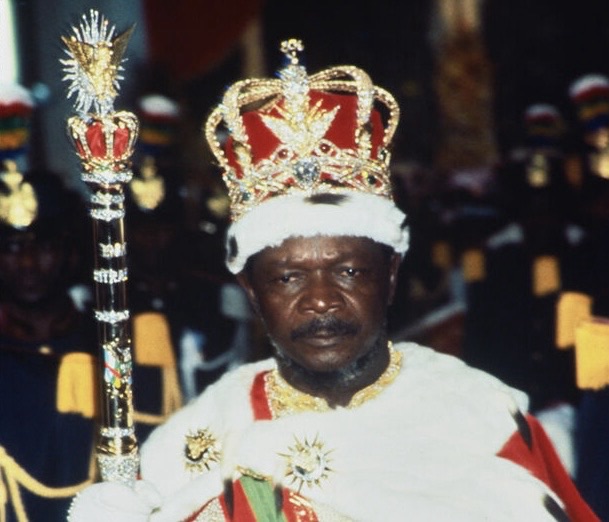
In an extraordinary move, after almost a decade into his tenure as president, Bokassa renamed the Central African Republic the Central African Empire in 1976. A year later, he crowned himself Emperor Bokassa I, the self-proclaimed monarch of his new Empire. He announced the monarchy would be hereditary. This title was unrecognised by most royals and nations across the globe, reflecting just how isolated Bokassa’s regime had become. On December that year, the Coronation of Bokassa I took place, in an attempt to legitimise his title. He personally invited guests, with world leaders such as Emperor Hirohito of Japan and Shah Mohammad Reza Pahlavi of Iran being on the top his list. Both of them rejected his invitations. In fact, most global figures stayed away, leaving the event largely isolated diplomatically. The only Royale present was the Prince of Liechtenstein. Even other authoritarian leaders across the continent such as Idi Amin of Uganda and Mobutu Sese Seko of Zaire refused to go. Despite this, the ceremony went ahead at enormous cost, estimated at roughly a third of the country’s annual budget, an astonishing figure given the country’s economic situation.3
As Emperor, Bokassa I became known for a brutal and repressive regime marked by political imprisonment, torture, and the suppression of opposition. Similarly to Idi Amin, he was the subject of shocking allegations, including claims of cannibalism, though these remain debated and not definitively proven. What is firmly documented, however, is the violence carried out under his rule. In 1979, protests erupted after students were forced to wear school uniforms reportedly produced by one of Bokassa’s 17 wives. The demonstrations were met with mass arrests, and many students were detained at Ngaragba Prison, where they were beaten, tortured, and killed. Reports indicate that Bokassa himself visited the students in prison and beat some of them to death using a cane. 4 5

Photo: BBC News
Meanwhile, relations between Bokassa and France began to deteriorate. He had previously maintained close ties with French President Valéry Giscard d’Estaing, even gifting him diamonds. Despite this good relationship, the French President surprisingly did not attend Bokassa’s coronation. This diamond gift, which Giscard d’Estaing received before his presidency began, in turn would lead to a political scandal in France, which contributed to him losing his 1981 bid for re-election. 6 This incident aside, Bokassa got along well with France until their relationship turned sour following Bokassa seeking for a close alliance with Muammar Gaddafi of Libya. The French saw it as a threat to its influence in the region. 7 So much so, that the French counsellor on African affairs requested to Bokassa that he abdicated. Bokassa responded, by threatening to beat him with a cane. 8 Tensions escalated rapidly, and French support for Bokassa began to collapse.
In September 1979, while Bokassa was abroad, France launched Operation Barracuda, a military intervention designed to remove him from power. With French backing, David Dacko was reinstated as the third president, and the Central African Empire was swiftly dissolved, reverting the country back to a republic. The empire had lasted less than three years. Bokassa fled to France, making use of his French citizenship. 9
He later returned to the Central African Republic in 1986, where he was arrested and put on trial. Initially sentenced to death, his punishment was commuted to life imprisonment, and he was eventually pardoned in 1993 by fourth President André Kolingba (who deposed David Dacko in a separate coup in 1981).10 Bokassa died in 1996 of a heart attack, closing the chapter on one of Africa’s most unusual political figures. 2
While Bokassa’s story sounds surreal, that of an emperor in a newly independent African state, staging a lavish coronation while ruling through fear, it reflects deeper realities about post-colonial instability, foreign influence, and the dangers of unchecked power. The Central African Empire may have been short-lived, but it remains a striking example of how fragile political systems, combined with personal ambition, can produce one of the most extraordinary episodes in modern history.
1 France’s poisoned legacy in the Central African Republic – The Guardian
2 Africa’s Napoleon? The Coronation of Jean-Bédel Bokassa – New Histories
3 Central African Republic – Independence | Britannica
4 Bokassa Successor Says Dictator Killed Children in April Massacre – The New York Times
5 Survivors Describe Massacre in Bangui – The New York Times
6 The Story of Giscard d’Estaing’s Fascination for Emperor Bokassa’s Diamonds – InDepthNews
7 France and its African policy – International Viewpoint
8 French Reject Bokassa, Keep Him Waiting on Jet – The Washington Post
9 Bokassa’s Overthrow and French Intervention – HistoryRise
10 The other version of the crisis in the Central African Republic – ICIP (Peau en Progress magazine)





Leave a Reply