
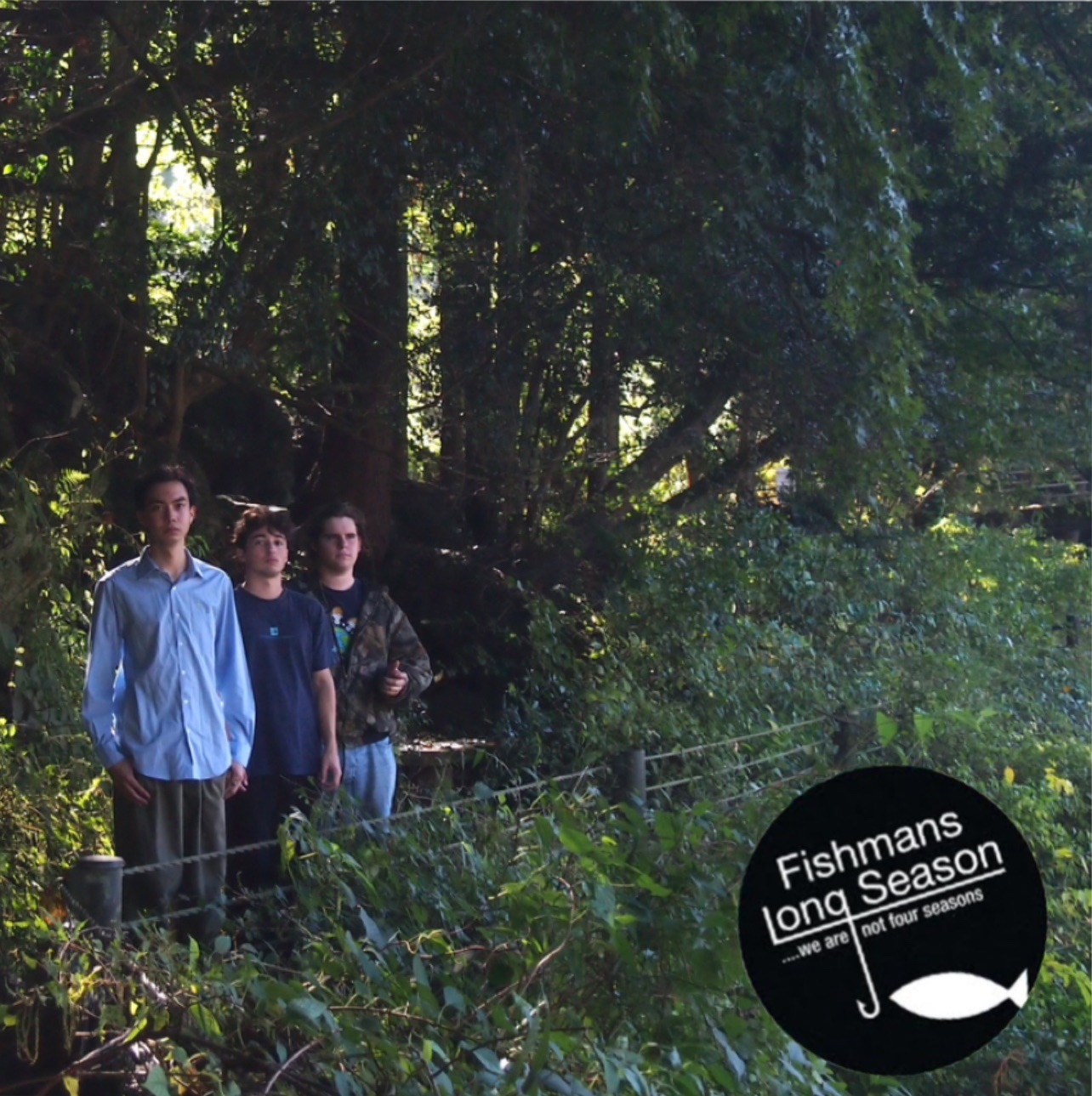
In November 2024, I travelled to Mitake, western Tokyo, to visit the location of Fishmans’ Long Season album cover. I had been listening to the Japanese band since I was 16, but only after entering Meiji Gakuin University did I discover they’d formed at the same university. I eventually made the three-hour journey with three friends from South Africa, the United States and the Philippines. Four people with connections to different parts of the world had come together in Japan over a band that began in our own university’s music circle.
I first discovered Fishmans in late 2020, when I was 16 and in my first year of secondary school in Japan. Their music stood out to me for its unusual combination of reggae and dub, dream pop and psychedelia. At the centre of their sound was vocalist Shinji Sato, whose distinctive voice gave the band’s music an almost dreamlike quality. Among their discography, Long Season became my favourite. Released in 1996, the album consists of a single composition lasting approximately 35 minutes, divided into several evolving sections.The tune moves through shifting melodies, layers of instruments and extended instrumental passages. It is an album that rewards listening from beginning to end.

Most fans would describe the live version on “98.12.28 Otokotachi no Wakare” as the definitive edition, recorded at what became the band’s final concert with Sato. His death in 1999 brought Fishmans’ original era to an end, leaving behind a relatively small catalogue that would eventually find a much larger audience. During their original run, Fishmans achieved modest commercial success in Japan, with albums that did not reach the mainstream popularity of many of their contemporaries. Nevertheless, they have developed a devoted cult following abroad in the decades that followed, and the band’s reputation continued to grow after Sato’s death.
Much of their international rediscovery took place online. Music communities and forums, including 4chan’s music board and Rate Your Music, helped introduce the band to listeners who might otherwise never have encountered them. Long Season currently sits as the 29th most highest rated album of all time on Rate Your Music.

Iconic album cover for 98.12.28 Otokotachi no Wakare
After passing my entrance exam for Meiji Gakuin University in early 2023, I looked up some of its famous alumni and discovered that Fishmans had formed there in 1987. The band had started as members of a music circle that still exists today, which made the connection even more surprising. At my entrance ceremony, I was thrilled to see the university’s music circle where Fishmans had formed advertising itself with photographs of the band. Later, I watched the 2021 Fishmans documentary and recognised the campus as drummer Kin-ichi Motegi walked through it, which made me unexpectedly happy.
I had long wanted to visit the location of the Long Season cover. The photograph features three members of Fishmans standing beside a handrail in a wooded area near Mitake. The location was approximately three hours away by train, and I had no friends who knew the band well enough to make the trip with me. That changed when I met a fellow student from South Africa who also listed Fishmans among his musical interests during class. We decided to visit the location together and eventually invited two more friends.

Between us, we represented four different backgrounds: British-Japanese, South African, American and Filipina. We were all studying at the same Japanese university, brought together by our interest in a band that had formed there almost 40 years earlier. After taking the train to Sawai Station, we walked through the surrounding area before continuing towards Mitake. The scenery was beautiful, with autumn leaves covering the landscape and the river running below the bridges. It was a lovely change from the city, although the November heat made the walk feel more like summer.


When we reached the wooded area near the original photograph’s location, we discovered that part of the landscape had changed. A section of the smaller bridge visible in the original cover photograph had been destroyed by a typhoon in 2017, and access to the area had been restricted. Despite the missing section, we were able to see the remaining handrail and the surroundings that had appeared on the album cover. We also noticed messages left by previous visitors, including people who had written the band’s name on the structure. We took turns recreating the original photograph, with me changing into a blue buttoned shirt to resemble the one Sato wore. Seeing the landscape in person felt surreal. A place I had known through a photograph accompanying music I had listened to for years was suddenly in front of me.

In 1996, three Japanese Meiji Gakuin students posed beside a handrail in the mountains for the cover of Long Season. 28 years later in 2024, four of us stood in the same place to recreate the photograph. We had different backgrounds, all coming from different continents, but we had all ended up at Meiji Gakuin University, where Fishmans had formed decades earlier.
In 2025, I had the chance to see Fishmans perform live, another experience I wouldn’t have imagined when I first started listening to them. The band played Long Season for around 40 minutes, truly a blessing to my ears. Fishmans are set to perform again in 2027. Nearly three decades after Long Season came out, their music is still reaching people who weren’t there when it was first released, and those who don’t even understand the Japanese lyrics. I’d recommend any Fishmans fan make the trip to Mitake. The river and surrounding trees are beautiful, and it’s worth visiting even beyond the chance to see the place featured on the Long Season cover.


Leave a Reply