
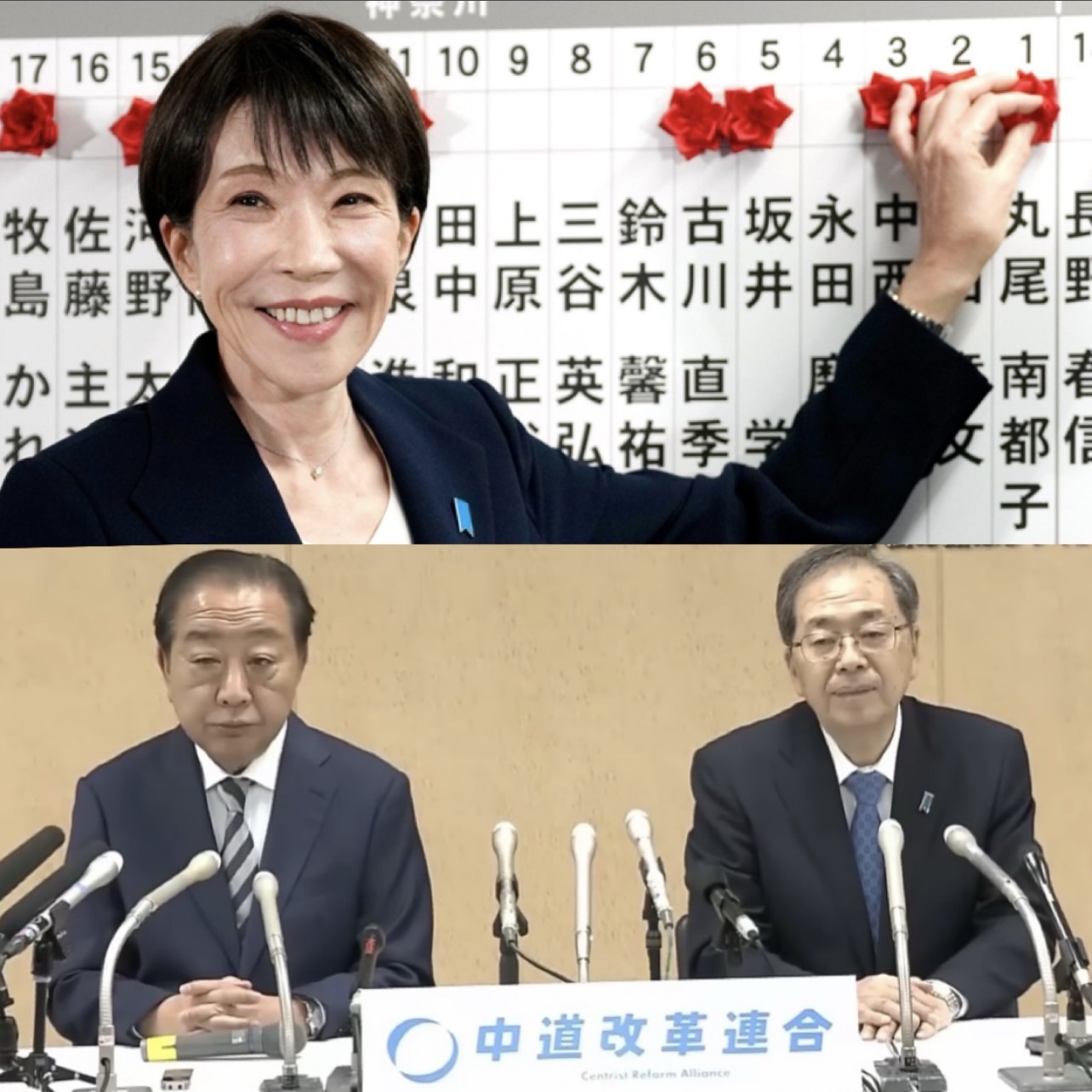
Photo: Takaichi’s victory, BBC News (above), Noda and Saito’s defeat, TBS News (bottom)
Big news from Japan. The Liberal Democratic Party won yet another general election. Again. Was it ever really in doubt? In a previous article, I broke down what the Centrist Reform Alliance (CRA) was, and what the merger of two major opposition parties could mean heading into an election just weeks away. In this piece, I’ll look at how the CRA actually performed, why it struggled, and how the LDP managed to recover after a few shaky years.
Firstly, let’s talk about the background of the LDP in recent years. I suggest you read this article I wrote about the previous part leader and Prime Minister, Shigeru Ishiba. In that article, I break down how support for the LDP had dipped during his premier. Even so, they still managed to win elections, partly because of how Japanese politics tends to work. The shadow of 2009–2012 still hangs over everything. When the LDP lost power back then, the new government lead by the Democratic Party struggled with scandals and unmet expectations. For a lot of voters, especially older ones, that period reinforced the idea that, whatever the LDP’s flaws, it’s the “safe option.” 1 So even at a low point, the party still had a solid base to fall back on. Ishiba eventually stepped down after his approval ratings slid, and was replaced by Sanae Takaichi in late 2025. That shift ended up mattering more than many expected.
In the months leading up to the election, Takaichi’s profile rose quickly. She projected a much firmer image, especially on foreign policy. When she suggested that Japan would not stay passive in the event of a Taiwan contingency, it immediately triggered backlash from China. 2 There were calls within China to rethink travel and economic ties with Japan, which added a layer of real-world consequence to what might otherwise have been seen as just rhetoric. Her comments about Taiwan and China drew criticism abroad, but domestically they landed quite differently. 3 For many voters, it signalled strength at a time when regional tensions felt increasingly real. Another reason for her rising popularity was to do with her relationship with U.S President Donald Trump. Whether you like that or not, there’s a clear precedent: Their relationship seemed to be reminiscent of former Prime Minister Shinzo Abe’s “special friendship” with Trump, reviving that era of Japan-US relations under Trump that seemed to be lacking when Ishiba was in power. 4 On top of that, her tougher stance on immigration appealed to a segment of voters looking for clearer direction on the issue. 5
But what really stood out was her unexpected popularity among the younger generation. Many young people who had never shown an interest in politics were showing interest in the Prime Minister, as she started trending on social media in ways you don’t usually see for Japanese politicians. The fact that she was a woman in a space dominated by men was symbolic to youngsters. The whole “Sana-katsu” phenomenon, which revolves around her fashion style, handbags and following her as if she were a celebrity. 6 7 The term is so popular it even has its own Japanese Wikipedia page. “Sana-mania” was a phrase that appeared across multiple sources and social media accounts. 8 This contrasted sharply with Shigeru Ishiba’s public image. His support, particularly among younger voters, was limited and increasingly shaped by online backlash and disengagement, rather than genuine enthusiasm.
Then came January. On the 14th, Yoshihiko Noda, the leader of the opposition Constitutional Democratic Party (CDP), and Tetsuo Saito, the leader of the LDP’s former partner Komeito, announced that their two party’s will merge in the Lower House, to create the “Centrist Reform Alliance” (CRA). They aimed to bring Japanese politics back toward the centre after what many saw as a rightward drift. This came as a sudden and confusing announcement, as CDP voters who were anti-Komeito and vice versa struggled on whether they felt the CRA deserved their vote or not. Was this a temporary alliance or something more permanent? Why only the Lower House? And why now, right before a possible election? Those questions never really got clear answers.
A few days later, on the 19th of January, Takaichi announced that the Diet would be dissolved, and that a general election was to be held in early February. She stated it was to see if the general public were happy with her, three and a half months into her tenure, and whether they were satisfied with how her party and its new merger with the Japanese Innovative Party (JIP). This seemed to be a calculated move. Her popularity was climbing, the opposition was mid-adjustment, and the timing couldn’t have been much better for her. One could make out that she decided to take advantage of all these factors.
The LDP and the JIP, secured a clear victory. Not necessarily because the party itself had transformed overnight, but because Takaichi had shifted the momentum, and the opposition never quite found its footing. The CRA, on the other hand, underperformed badly. The LDP went from 198 seats to 316, whilst the CRA’s seats reduced from 172 to 49. 9 To take accountability for this huge loss, Yoshihiko Noda and Tetsuo Saito resigned from their positions, making them joint party leaders for just three weeks.
Had the Centrist Reform Alliance not existed, or had the Constitutional Democratic Party of Japan and Komeito chosen to cooperate more loosely rather than merging in the Lower House, the CDP might have had a stronger chance of building momentum, and potentially challenging for power for the first time since 2012. Instead, the way the alliance was handled worked against them. Due to Noda and Saito’s mismanagement and the awkward timing to merge parties, both weakened themselves. Instead of benefiting both parties, the alliance left them stuck together at one of their lowest points in recent years. While it’s not certain they expected an election to be called so soon, rolling out such a significant political shift so close to one left little time to convince voters.
So what does this all come down to? More than anything, this was Takaichi’s election. Her personal momentum, her image, and her timing did most to benefit her party. It is important to remember that this was not purely a party-driven revival. The opposition being unprepared also contributed to the LDP’s massive landslide victory. The next phase for the opposition depends on figures like the new CRA party leader Junya Ogawa and whether they can rebuild themselves into something clearer and convincing for voters. That likely means simplifying their message, resolving internal contradictions, and deciding what they really stand for, not just who they’re trying to oppose.
For now though, the takeaway is simple: the LDP didn’t just win because it was strong. It won because, at the right moment, the party leader was strong, and the alternative looked weak.
1 Asahi Shimbun, “Voters wary of opposition after past failures,” https://www.asahi.com/ajw/articles/15480867
2 Politics Today, “The Breakdown in Japan-China Relations,” https://politicstoday.org/the-breakdown-in-japan-china-relations/
3 TBS NEWS DIG, “世論調査:高市首相の台湾発言について,” https://newsdig.tbs.co.jp/articles/-/2333600?display=1
4 JBpress, “『日中友好』という蜃気楼と台湾有事発言がもたらした影響,” https://jbpress.ismedia.jp/articles/-/91812
5 The Japan Times, “Takaichi makes final appeal to voters ahead of election,” https://www.japantimes.co.jp/news/2026/02/07/japan/politics/takaichi-final-appeal-voters/
6 第一生命経済研究所 (Dai-ichi Life Research Institute), “高市政権と日中関係・台湾問題に関する分析,” https://www.dlri.co.jp/report/ld/534431.html
7 DIME, “高市首相の台湾発言に対する世論と評価,” https://dime.jp/genre/2051129/
8 The Guardian, “’Sana-mania’ grips Japan as ultra-conservative Takaichi expected to secure election landslide,” https://www.theguardian.com/world/2026/feb/06/sana-mania-grips-japan-as-ultra-conservative-takaichi-expected-to-secure-election-landslide
9 The Japan Times, “Japan election chart,” https://www.japantimes.co.jp/election-chart/


Leave a Reply