
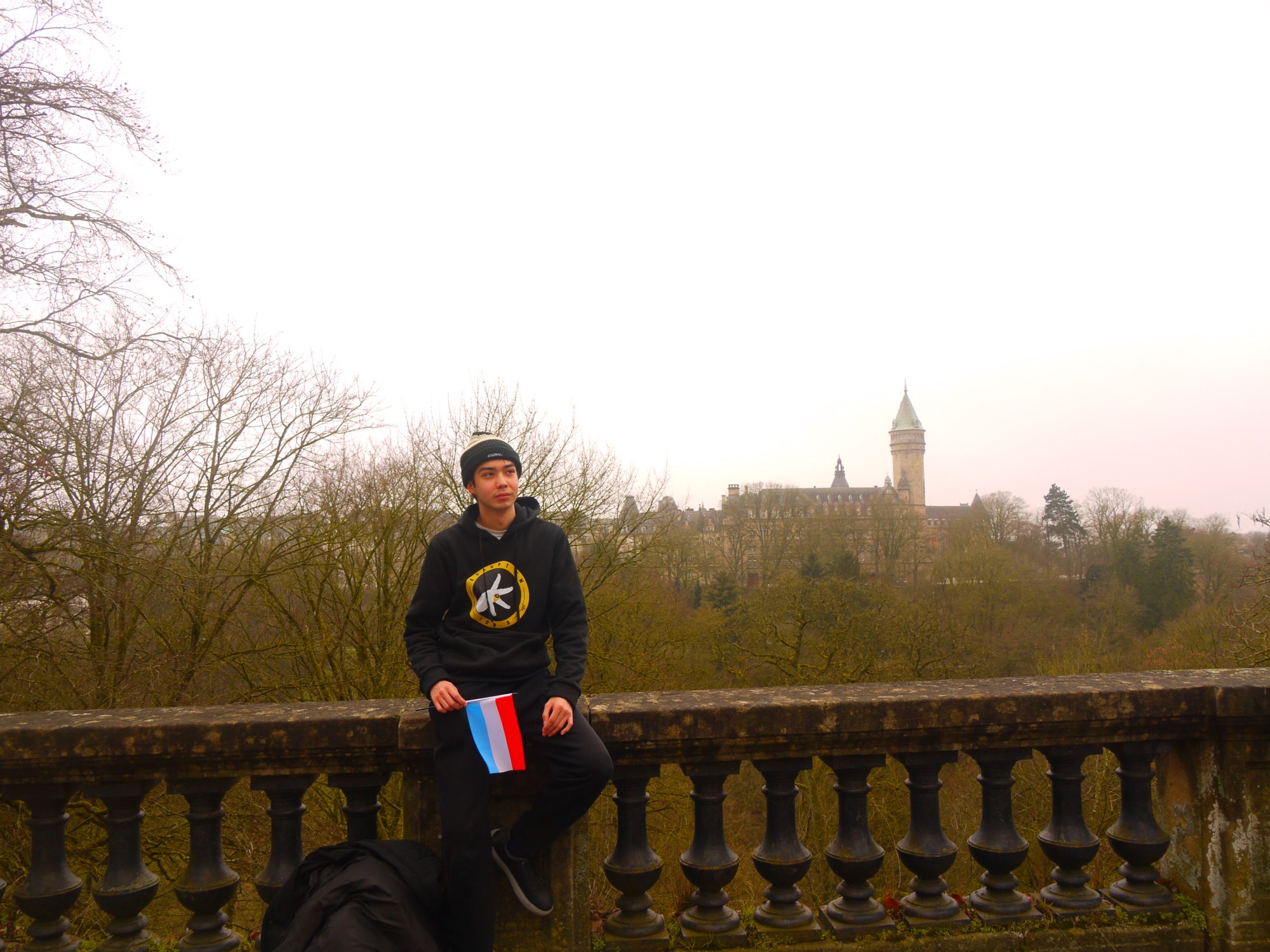
Luxembourg was one of the most interesting places I have ever visited. The capital city was the most unique I had been to thus far, and it was absolutely stunning. In today’s article, I will go over why I chose Luxembourg of all places to visit, share my thoughts on the capital city where I spent most of my time, and describe an unexpected encounter I had with a Luxembourgish woman who kindly spoke with us on the train. Our conversation touched on life in Luxembourg and her views on immigration, an exchange that left a lasting impression on me and felt worth sharing.
Having two backgrounds, I visit England whenever I get the chance to see my family and revisit the places from my childhood. Because of this, I do not often have many opportunities to explore other countries. Going back to England does not feel like travelling abroad to me, it simply feels like returning to my other home. In the past few years, however, I have managed to visit several countries for a few days at a time. This time was especially exciting because it was the first time I travelled to new countries without my parents. The countries I chose were Belgium, Luxembourg, and Germany, which I visited over the course of three days during a short break in my spring trip to England.

I was most excited about Luxembourg. Being the country nerd that I am, my favourite countries tend to be the ones people talk about the least. There is something about these nations that intrigues me, though I find it hard to explain exactly why. Perhaps it is the idea that although we rarely hear about them in everyday media, they are real places where people live their ordinary lives. Being from Luxembourg is perfectly normal for people who live there, yet living in Japan I almost never hear about the country at all. Either in daily life or online.
The first destination on our trip was Brussels in Belgium. Brussels was incredibly busy. Nothing screamed “this is a capital city” to me more than the loud crowds, the tourists, the street performers, the tall buildings, and the famous Grand Place. Everywhere we went we heard cars honking, which only reinforced how busy the city felt. Luxembourg, however, turned out to be the complete opposite.
The morning after visiting Brussels, my girlfriend and I took the train to Luxembourg. During the journey I kept checking our location on Google Maps. Bit by bit, our location moved closer to the edge of Belgium. A few stops before we were meant to arrive in Luxembourg, however, I noticed something strange. Judging by how long it took between each station, there seemed to be no way we could reach Luxembourg City in just a few minutes, as the train board suggested. I even started to wonder whether the train might only take us to the border, and that we would need to transfer to another train to reach the capital. The moment we crossed into Luxembourg, something funny happened on Google Maps. Because the country is so small, the map suddenly zoomed in. Our “current location” marker sped across the country, and before I knew it we had reached the capital only minutes later.
Almost immediately, I noticed how different Luxembourg felt compared with Belgium, although I had only seen Brussels, and England. The trams, the roads, and especially the quietness stood out to me. When we crossed the bridge into Luxembourg City, the scenery around us suddenly felt distant and almost unreal. The valleys, forests, and castles we had been looking at earlier now appeared far away, almost like a horizon surrounding a floating island.

On this “island,” we visited the beautiful cathedral and walked through the main city centre. What struck me most was the lack of tourists. The streets were incredibly quiet. There were a few homeless people here and there like there were in Brussels, but aside from that the usual bustle you might expect from a capital city simply was not there. No constant honking, no overwhelming crowds. The buildings around us looked almost like something out of Disneyland. Beautiful, carefully designed, and strangely peaceful. I found myself wondering: was this really the capital city of an entire country?

Perhaps the most surprising sight was the Grand Ducal Palace. Luxembourg is the only remaining country whose head of state holds the title of Grand Duke. In front of the palace stood the flags of Luxembourg and the European Union, while a lone soldier, who looked about my age, marched back and forth with a blank expression. Around us were only about ten people, one of them quietly taking photos. This peaceful palace is the equivalent of Buckingham Palace for Luxembourg, yet the atmosphere was so quiet that it almost felt surreal. Was this even a real country? – I joked.

Public transport in Luxembourg is also free. We hopped onto buses and stepped off again without tapping any cards or even interacting with the driver. During this short visit, I genuinely felt as though I had stepped into an alternate dimension. I cannot say what it would be like to live there, but I can confidently say that Luxembourg City is one of my favourite places I have ever visited.
At our Airbnb, we had a memorable encounter. A student from France who was staying there for his exams helped us when we were looking for the “free food” that the Airbnb description had mentioned. When he could not find any, he simply opened a cupboard full of eggs, cup noodles, and other food and offered it to us instead. When we asked whether the eggs belonged to the Airbnb, he casually admitted that they were actually his. This student, who was around our age and whom we had only just met, was willing to share his own food without even planning to tell us it was his. That small gesture genuinely warmed my heart.

On the third day of our trip, we took a train from Luxembourg to Trier in Germany. The main reason was simply so that we could say we had visited Germany, but Trier turned out to be a lovely town. It provided a quieter and more relaxed way to end our three days of travel.
Later that day, we boarded a train from Trier back to Luxembourg, as we were flying from Luxembourg Airport back to England. As we settled into our seats, a woman sat across us who looked to be around fifty-five years old was beaming at us. “Where are you from?” she asked. That simple question led to a long conversation. She told us that she had been born in Luxembourg and had lived there her entire life. She confirmed that around 47 percent of the country’s population is foreign and explained how many people commute into Luxembourg every day from France to work, returning home each evening. She even mentioned that many of the nurses and doctors she had encountered in her life were French.
As the conversation continued, however, the topic gradually shifted toward immigration. Her tone changed noticeably as she spoke about how, in her opinion, Luxembourg and Europe had become less safe due to immigration. Some of the language she used made me uncomfortable, particularly when she began listing specific groups of people who had arrived in Europe during the past fifteen years as conflicts had erupted around the world. Even so, I chose not to interrupt or argue. Instead, I listened. I knew I would likely never meet this woman again, and hearing different perspectives, especially from people who actually live in the places we visit, is something I value greatly. After all, when would I ever have another opportunity to hear the candid thoughts of someone who had lived her entire life in Luxembourg?
She spoke openly about how she felt the streets had changed and how she no longer felt as safe as she once had. She insisted she was not trying to frighten us but was simply telling us what she believed to be the truth. While I did not agree with everything she said, I reminded myself that one person’s views do not represent an entire country. What fascinated me most was how comfortable she felt sharing such personal opinions with two strangers she had just met on a train.
When we arrived at the station, she got off at the same stop as us. After hearing that we planned to take the bus to the airport, she kindly guided us out of the station and to the tram stop instead, explaining that it would be faster. She carefully told us which stops to watch for and where to get off. Before we boarded, she asked for our names and shared hers as well. As the tram doors closed, she waved goodbye. I could tell that this brief encounter will stay with me for a long while.

In Japan there is a four-kanji idiom, ichigo-ichie, which roughly translates to “one time, one meeting.” It expresses the idea that every encounter in life is unique and will never happen in exactly the same way again. Because of that, each moment and each meeting should be valued. Our conversation with the woman on the train reminded me strongly of this idea. I may not have agreed with everything she said, some of her views felt extreme to me, but listening to her perspective allowed me to understand a little more about how someone from Luxembourg experiences changes in her country. Rather than argue, I chose to listen, recognising that she was speaking from her own lived experience while I was only a visitor passing through.
That short conversation, like the kindness of the French student at our Airbnb, became one of the most memorable parts of the trip. Encounters like these remind me that travel is not only about the places we see, but also about the people we meet, brief moments of connection that will never happen in quite the same way again. I had many similar conversations during my whole 6 week visit to England from the middle of January to the last day of February this year.




Leave a Reply