
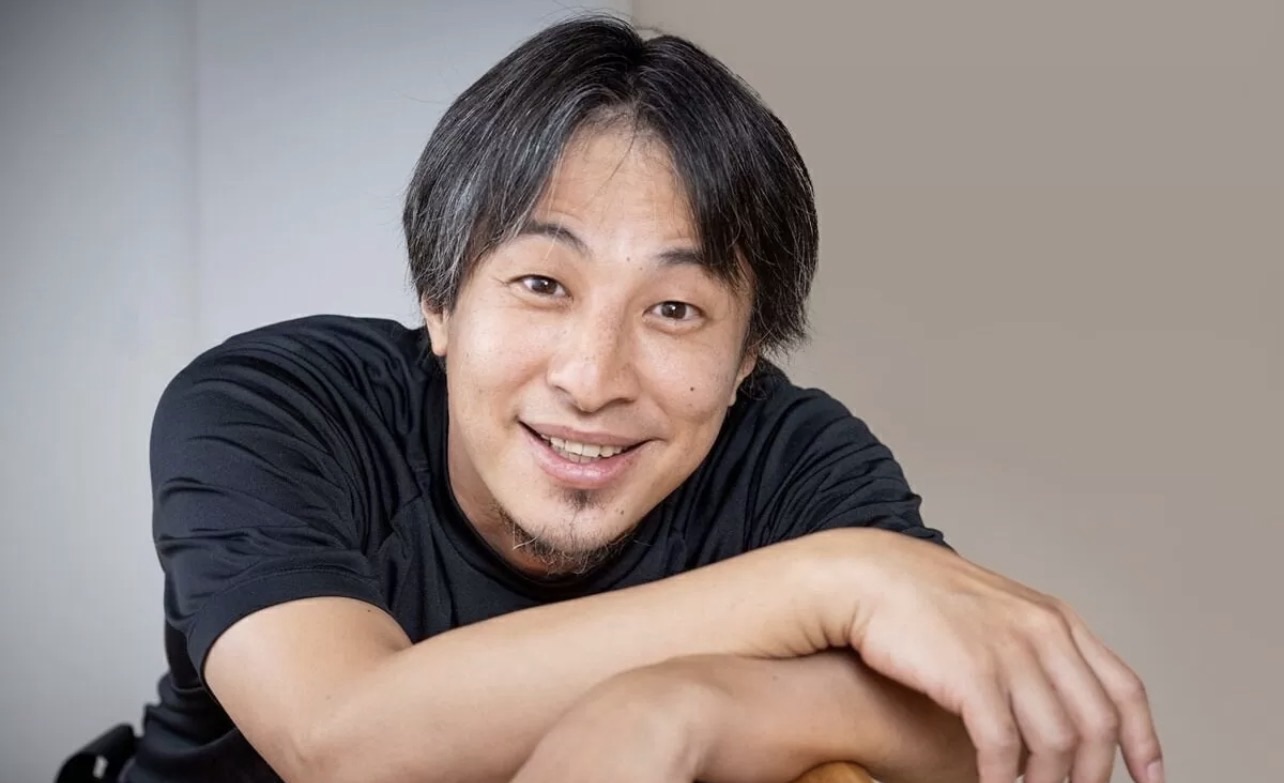
Photo: MyNavi News
Hiroyuki Nishimura, better known simply as “Hiroyuki”, is something of a legendary figure in Japanese popular culture. Starting his career off by creating 2channel, an anonymous internet message board in the late 1990s eventually made him one of Japan’s most recognisable internet personalities. Over the years, Hiroyuki has moved far beyond the world of online forums, becoming a television personality, author, businessman, media commentator and, increasingly, a participant in Japanese politics.
His influence extends outside of Japan, as he became the owner of 4chan in 2015, the American imageboard that had itself been inspired by 2channel. In July 2026, Hiroyuki took another major step into public life when he and former Akashi mayor Fusaho Izumi established a new regional political group. This article explores how Hiroyuki became such a culturally significant figure, the achievements and controversies that have surrounded him, and why he is now attempting to enter politics.
Hiroyuki was born in Sagamihara, Kanagawa Prefecture, in 1976. He moved to Tokyo shortly after his birth and grew up in Akabane, in Tokyo’s Kita Ward. He attended Chuo University before studying in Arkansas in the United States. While in America, he established 2channel, an anonymous message board where users could create discussions and post without having to identify themselves, in 1999. Whilst anonymous online forums already existed in Japan, with 2channel being influenced in part by the earlier site Amezō, Hiroyuki’s creation became extraordinarily successful. Its anonymity and enormous range of discussion boards allowed users to discuss almost anything, from entertainment and technology to politics, personal problems and current affairs. The site eventually became one of the defining spaces of early Japanese internet culture.
Its lack of conventional identity and moderation also made 2channel controversial. The site became associated with racist and xenophobic comments, harassment, crime-related discussions and defamatory posts. Hiroyuki himself subsequently became involved in numerous legal disputes over material posted on the site. Hiroyuki took a famously hands-off approach to moderation, arguing that 2channel was a platform for its users rather than a publisher responsible for their posts. This philosophy would become central to Hiroyuki’s public image, as he was simultaneously seen as the creator of an important new form of communication as well as someone willing to tolerate material that traditional media organisations would never publish.

Photo: Saorin no Nikkichou
In May of 2000, the Nishi-Tetsu bus hijacking became one of the earliest major crimes in Japan to draw national attention to the relationship between the internet and criminal activity. The 17-year-old perpetrator had posted on 2channel shortly before hijacking a bus and taking 21 passengers hostage, killing one. Hiroyuki subsequently appeared in an interview on TV Asahi’s News Station, explaining how the anonymous board worked. It was his first major television appearance, introduced his face to the wider public.
His appearance did not necessarily match the image people might have expected of the mysterious administrator of a huge anonymous message board. Contemporary internet discussions reacted to photographs of Hiroyuki with comments describing him as an unexpectedly pleasant-looking young man and even as handsome. The television appearance also produced one of Hiroyuki’s most famous quotations: “You need to be able to distinguish lies from lies (or it will be hard to use the message board).”
In 2005, Hiroyuki became a director of Niwango, the company behind the video-sharing service Nico Nico Douga. He would eventually become a familiar face on Japanese television and internet programmes, where his deliberately blunt style of debating and commenting on current affairs helped transform him from an internet administrator into a mainstream media personality. He has appeared on numerous discussion and variety programmes, often debating politicians, comedians, journalists and other public figures. His style, consisting of short, direct answers and an apparent willingness to challenge the assumptions of the person interviewing him, eventually earned him the nickname “the king of debate.” He has also written numerous books, and has expanded his audience on his YouTube channel. Clips of Hiroyuki answering questions, discussing news and debating other personalities became particularly popular. According to ABEMA, his YouTube clipping videos reached around 300 million views per month in 2021.
In 2023, ABEMA produced Sekai no Hate ni Hiroyuki Oitekita (“We Left Hiroyuki at the End of the World”), in which Hiroyuki was dropped in Namibia and required to travel across Africa under a limited budget and using overland transport. A second series subsequently took him and actor Masahiro Higashide through South America. This shows how far Hiroyuki had come since his days running 2channel.

Photo: Daily Sports
Hiroyuki became particularly well known outside Japan in 2015, when Christopher “moot” Poole, the American founder of 4chan, announced that he had sold the website to Hiroyuki. 4chan had originally been created in 2003 and was heavily influenced by Japanese imageboards, especially 2channel. Its acquisition brought the story full circle: the Japanese creator of the imageboard that had helped inspire 4chan had eventually become its owner.
4chan had become one of the most influential and infamous anonymous imageboards in the English-speaking internet, particularly within anime, gaming and meme culture. It was also considerably more controversial, becoming associated with harassment campaigns, extremist communities and other contentious forms of online activity. Investigations by Wired have examined the site’s links to extremist movements and violent incidents. Hiroyuki’s ownership therefore gave him influence over two of the most historically significant anonymous message-board communities on the internet.
Hiroyuki’s career has also been marked by controversy, much of it involving lawsuits over the websites he has run. His approach to user-generated content has repeatedly brought him into legal disputes over what was posted onto those sites and who should be held responsible for it. His relationship with 2channel itself eventually became complicated as a dispute over the site’s domain and ownership occurred, resulting in him losing control of the original 2ch.net domain and subsequently established 2ch.sc, a separate site. This meant that Hiroyuki was eventually operating a competing version of his own 2channel.
His ownership of 4chan has brought another set of controversies, particularly because of the site’s reputation for allowing content that would be prohibited on more heavily moderated social-media platforms, such as Neo-Nazism. Nevertheless, Hiroyuki has remained a prominent media personality rather than retreating from public life.
In July 2026, Hiroyuki would go on to announce something major that would tie him directly to the political world. On July 27, Hiroyuki and Fusaho Izumi registered a political party under the provisional name “Hiroyuki & Izumi New Party.” The two serve as co-representatives. The organisation plans to recruit candidates for the 2027 unified local elections, initially focusing on mayoral and ward-mayoral elections rather than immediately attempting to build a conventional national parliamentary party. The partnership is unusual because Izumi comes from a very different background with a very different career.

Photo: Tokyo Shinbun. A book that Hiroyuki and Izumi wrote together in the past.
Fusaho Izumi is a lawyer, former NHK employee and former member of the House of Representatives who became mayor of Akashi, Hyogo Prefecture, in 2011. He served as mayor for three terms and 12 years, leaving office in 2023. He was subsequently elected to the House of Councillors from Hyogo in 2025. Izumi became nationally known for his aggressive focus on child and family policy in Akashi. His administration introduced what became known as the city’s “five free services”, including free medical care for children, free school lunches and free childcare for second children and beyond, alongside other measures intended to reduce the cost of raising children.
His record, however, has also been highly controversial. Izumi resigned as mayor in 2019 after making threatening remarks to a city employee, then successfully ran again after receiving significant public support. He later faced another controversy involving remarks directed at city councillors and announced his retirement from local politics before leaving office in 2023.
The new political party he would form with Hiroyuki three years later says it wants to start by changing local government rather than immediately concentrating on national parliamentary politics. Its stated goal is to demonstrate that policies introduced in Akashi can be implemented elsewhere. Among the ideas discussed by Hiroyuki and Izumi are expanding child-support measures, increasing the amount of money available to citizens through tax cuts and subsidies, promoting digital government and creating mechanisms to ensure politicians actually keep their promises that they make during elections.
One unusual proposal they made is a system under which candidates would commit themselves to submitting budgets or ordinances corresponding to their campaign promises after taking office, with the possibility of financial penalties if they failed to do so. The pair have described this as part of their wider goal of creating “politics that keeps its promises.” The organisation initially plans to seek candidates in all 11 Tokyo wards holding ward-mayor elections in the 2027 unified local elections. It is also considering candidates for gubernatorial elections in several prefectures and mayoral elections in designated cities. Longer term, Izumi has said that the party intends to expand into national politics.
The party’s formal name and detailed platform has not yet been finalised as of September 2026. The party has said that the official name and key policies will be announced after a public process in October.

Hiroyuki supporting Izumi at a political campaign
Hiroyuki’s career is unusual even by the standards of Japanese popular culture and internet celebrities. He began by creating a website where people could communicate anonymously, became one of the defining figures of Japan’s early internet, found himself at the centre of debates over online responsibility and free expression, and eventually became a mainstream television personality and author. He then acquired 4chan, extending his influence into Western internet culture, while his appearances on YouTube and programmes related to ABEMA have made him recognisable even to people who are not frequent internet users. Now, more than a quarter of a century after creating 2channel, Hiroyuki is attempting to build a political organisation. Whether the new party can translate the influence of two highly recognisable public figures into successful local government remains to be seen, but his move into politics marks yet another change in direction for someone whose career has repeatedly taken him far beyond internet fame.



Leave a Reply