
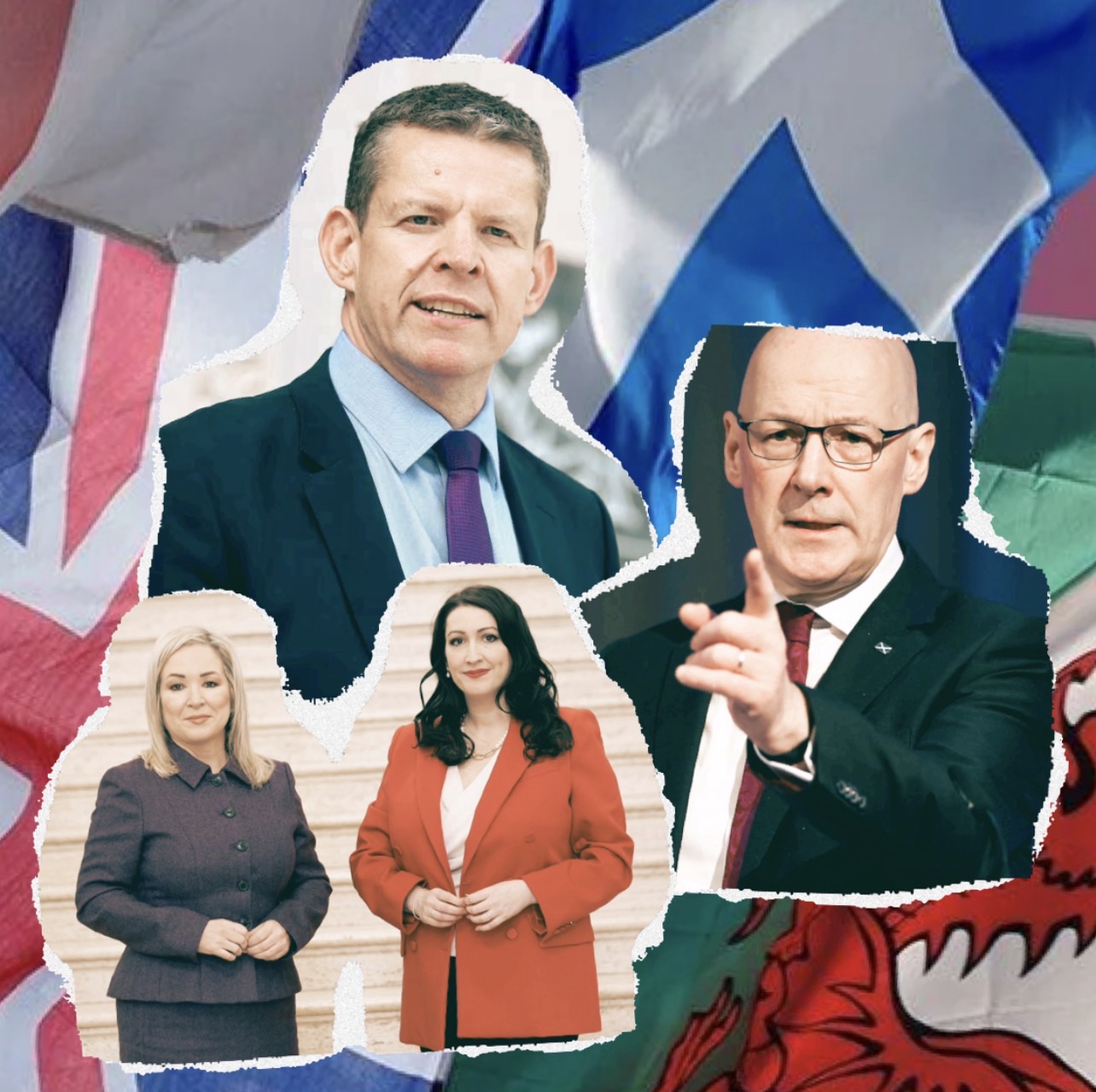
On the 14th of September, Scotland’s First Minister John Swinney, Wales’ First Minister Rhun ap Iorwerth and Northern Ireland’s First Minister Michelle O’Neill alongside Sinn Féin president Mary Lou McDonald met together in Cardiff to discuss the constitutional future of their nations.
The meeting came as the three devolved nations are all led by nationalist parties seeking major constitutional change. Swinney leads the Scottish National Party (SNP), which supports Scottish independence; ap Iorwerth leads Plaid Cymru, which supports Welsh independence; and O’Neill leads Sinn Féin, which supports Irish reunification, in which Northern Ireland would leave the United Kingdom and join a united Ireland. The three parties signed a memorandum calling on the UK Government to prepare, plan and facilitate constitutional change and recognising the right of their nations to determine their own futures. The meeting therefore raises the following question: could the United Kingdom eventually break apart? To understand why this is now being discussed, it is first necessary to understand what the UK actually is.

Photo: Prospect Magazine. From left to right, John Swinney, Rhun ap lorweth, Mary Lou McDonald, Michelle O’Neill
The United Kingdom is one sovereign state made up of four nations: England, Scotland, Wales and Northern Ireland. However, the four do not have identical political institutions. Scotland has the Scottish Parliament at Holyrood, Wales has the Senedd in Cardiff and Northern Ireland has the Northern Ireland Assembly at Stormont. England, meanwhile, has no separate national parliament and is largely governed directly through Westminster. This system is the result of devolution, a process through which certain powers were transferred from the UK Parliament and Government to Scotland, Wales and Northern Ireland during the late 1990s. Tony Blair’s Labour government introduced the modern system of devolution after winning the 1997 general election. Referendums in Scotland and Wales that year supported the creation of devolved institutions, while the Northern Ireland settlement formed part of the 1998 Good Friday Agreement. The Scottish Parliament, Welsh Assembly and Northern Ireland Assembly subsequently began exercising their powers in 1999. 1
Devolution gave the three nations greater control over areas such as health, education and aspects of transport and the economy. However, it did not make them independent. Westminster retained powers over areas including defence, foreign affairs and many aspects of taxation, and the UK Parliament remains constitutionally sovereign. This means that the United Kingdom is not a federation in which four equally sovereign states voluntarily share power. Instead, it is a single state with an asymmetric system of government, where different parts of the country possess different powers. That arrangement has increasingly become a source of political debate. 2

Photo: The New York Times
Scotland has had the strongest and longest-established independence movement. The Scottish National Party came into power in 2007, and in 2014, Scottish voters were given the opportunity to decide whether Scotland should become an independent country. Independence was rejected by approximately 55 percent to 45 percent, but the question did not disappear. Two years later, the UK voted to leave the European Union. Scotland had voted strongly to remain, creating another major constitutional disagreement. Scottish nationalists argued that Scotland had been taken out of the European Union against the wishes of its voters, strengthening the case for independence. 3
The SNP has continued to call for another independence referendum. However, Scotland cannot simply hold one whenever its government wants. The 2014 referendum happened after the UK Government agreed to give the Scottish Parliament the temporary power to hold it. This means another referendum would need agreement from Westminster, which has so far been a major point of disagreement between the Scottish and UK governments. 4

Photo: Spiked
Wales has followed a different path, as for much of the devolution era, Welsh politics was dominated by Labour. That changed dramatically in May 2026, when Plaid Cymru became the largest party in the Senedd and Rhun ap Iorwerth became First Minister. Plaid Cymru supports Welsh independence, but Wales does not currently have the same level of independence support or the same referendum history as Scotland.
Northern Ireland approaches independence differently. Unlike Scotland and Wales, the main nationalist objective in Northern Ireland is not the creation of an independent Northern Irish state. Sinn Féin supports Irish reunification, meaning Northern Ireland would leave the United Kingdom and become part of a united Ireland. Northern Ireland also has a constitutional mechanism that does not exist in Scotland or Wales. Under the Good Friday Agreement, Northern Ireland remains part of the United Kingdom for as long as a majority of its people wish it to remain there. If it appears likely that a majority would support joining a united Ireland, the Secretary of State for Northern Ireland is required to call a referendum, commonly known as a border poll. 5
The issue regarding Ireland received additional international attention only days before the Cardiff meeting. During a visit to Ireland on the 12th of September, US President Donald Trump said that he would “love” to see Ireland unified and suggested that he believed Irish reunification would eventually happen. His comments attracted criticism from unionist politicians, and for interfering in the politics of other nations. 6

Photo: Éirígí
The timing of the Cardiff meeting therefore brought together several developments that have traditionally been treated as separate issues, them being Scottish independence, Welsh autonomy and independence, and Irish reunification. Meanwhile, while Scotland, Wales and Northern Ireland debate the future of the United Kingdom, one small English village has already voted to leave. Piddington, an Oxfordshire village of around 350 people, held its own symbolic independence referendum on the 15th of September, with 285 voting in favour and just 26 against. This “referendum” was in protest against plans to house asylum seekers at a nearby former military site. The vote has no legal effect, but the villagers have since declared themselves the “Principality of Piddington”. 7
For now, the United Kingdom remains intact. The 14th of September meeting did not change that, but it showed how having nationalist parties leading all three devolved nations could potentially shape the future of the United Kingdom. Whether this eventually means more devolution, independent nations, Irish reunification, or simply a very awkward few years of arguments with Westminster remains to be seen. Let’s just hope somebody remembers to invite Piddington to the negotiations when it all begins.


Leave a Reply