
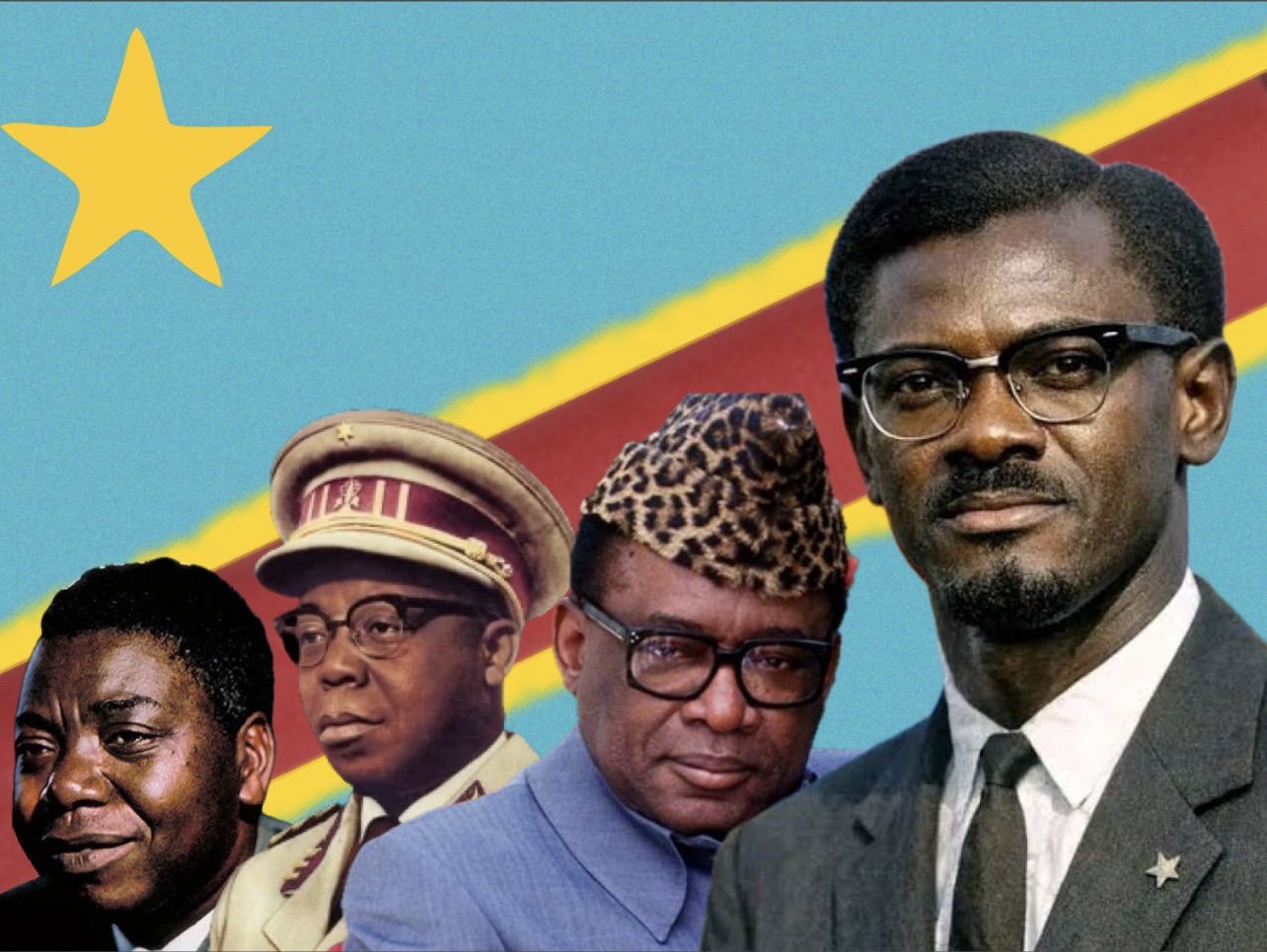
Left to right: Moïse Tshombe, Joseph Kasavubu, Mobutu Sese Seko, Patrice Lumumba
The independence of what is now the Democratic Republic of the Congo is one of the most complicated examples of decolonisation in Africa. Many people may be familiar with the story of Patrice Lumumba’s assassination, but his death was only one part of a much larger crisis that followed independence. Belgium granted the Congo independence in 1960, but this was quickly followed by military mutiny, foreign intervention, regional secession, political instability and Cold War rivalry. To understand how Lumumba came to be killed, and how Mobutu eventually rose to power, it is first necessary to briefly look at Belgium’s colonial rule.In the late nineteenth century, King Leopold II of Belgium controlled the Congo as his personal possession. His administration became notorious for forced labour and extreme violence in the extraction of the Congo’s natural resources. Colonial agents and soldiers would cut off the hands of Congolese people as punishment or to demonstrate that ammunition had been used against those resisting forced labour. Millions of Congolese died or disappeared during the Congo Free State period, although historians cannot establish a precise death toll. International criticism eventually forced Leopold to surrender the territory to Belgium in 1908. The Belgian government then formally took control of the Congo, but colonial exploitation and racial inequality continued. Belgian companies profited heavily from the country’s natural resources, while political power remained overwhelmingly in European hands. 1
By the 1950s, Congolese nationalism was growing, with several political movements calling for independence. One of them was Patrice Lumumba’s Mouvement National Congolais (MNC), which wanted a united and independent Congo. Lumumba was already a prominent anti-colonial nationalist before independence. He had become one of the best-known leaders of the independence movement and had been arrested by Belgian authorities during unrest in 1959. 2 His MNC also aimed to build support across the Congo rather than being limited to one region. By 1960, Lumumba was one of the country’s most prominent political figures.

Kasavubu and Lumumba. Photo via Afridesk.
In 1960, Belgium agreed to grant the Republic of the Congo independence, and on the 30th of June, the country became independent with Joseph Kasavubu as president and Patrice Lumumba as prime minister. Only days after independence, the Force Publique, the colonial army that still contained largely African soldiers commanded by Belgian officers, revolted. 3 Congolese soldiers protested against the continued presence of European officers and their lack of advancement. Belgium responded by sending troops into the Congo, officially claiming that it was protecting Belgian citizens.
The situation worsened, as Moïse Tshombe, the leader of the mineral-rich province of Katanga, declared independence from the Republic of the Congo. Katanga was particularly important because of its enormous mineral wealth and its close economic connections with Belgian companies. 4 The new Congolese government now faced several problems at once: a military mutiny, Belgian military intervention and the attempted breakaway of Katanga. Lumumba appealed to the United Nations for assistance. UN forces eventually launched Operation Grand Slam, entering Katanga and helping bring the breakaway province back under central government control. However, Lumumba had already become increasingly frustrated with the UN, which had initially refused to intervene against Katanga in the way he wanted. He then turned to the Soviet Union for help, bringing the Cold War into the Congo Crisis. Both Lumumba and President Kasavubu appealed for Soviet help, although Lumumba became particularly associated with the decision. 5

Tshombe, leader of Katanga. Photo via Shutterstock.
The United States became increasingly concerned about Lumumba’s relationship with the Soviet Union. Washington feared that the Congo could become another country in which Soviet influence expanded during the Cold War. Lumumba, however, was primarily a Congolese nationalist and anti-colonial politician. His decision to seek Soviet assistance came after Belgium’s intervention and his frustration with the United Nations. Nevertheless, American officials came to regard Lumumba as a serious threat. 5
Meanwhile, relations between Lumumba and President Kasavubu deteriorated as they increasingly disagreed over how to handle the crisis, particularly over foreign intervention and the Soviet Union. In September 1960, Kasavubu dismissed Lumumba as prime minister. Lumumba responded by attempting to dismiss Kasavubu. 5 The country now effectively had two competing leaders claiming authority. It was during this political crisis that Joseph-Désiré Mobutu, the army’s chief of staff, entered the centre of Congolese politics.

Joseph-Désiré Mobutu, later Mobutu Sese Seko, seen in his iconic abacost and leopard hat. Photo via The Guardian.
Mobutu, a former journalist, had previously worked alongside Lumumba and had been appointed chief of staff of the Congolese army after independence. As he became closer to the Americans, on the 14th of September 1960, Mobutu seized power in a military coup. He announced that politicians would be temporarily removed from power while a transitional government was established. 6
Mobutu’s rise was welcomed by the United States and other Western powers, which viewed him as a useful anti-communist figure. Lumumba was placed under house arrest. He eventually escaped and attempted to reach his political stronghold in Stanleyville, but Mobutu’s forces captured him in December 1960. By this point, Lumumba’s political enemies were determined to prevent him from returning to power. During one incident, a soldier found a speech script in Lumumba’s pockets, in which he was declaring he was still Congo’s Prime Minister. The soldier screwed it up into a ball and put it in his mouth. 5 A similar incident appears to be captured in this video.

Photo: Foro Permanente de Política Exterior
In January 1961, Lumumba was transferred to Katanga, and on the 17th, Lumumba and two of his associates were executed by Congolese and Katangan forces. His body was subsequently secretly disposed of. In an attempt to prevent his grave from becoming a political symbol, his remains were destroyed, including through the use of acid. 7 A Belgian police officer involved in disposing of his remains kept two of Lumumba’s teeth as a personal souvenir, with one of them eventually being returned to Lumumba’s family in 2022. 7 Following his assassination, Lumumba became an international symbol of anti-colonialism, and his death came to represent the darker side of the Congo’s independence and the Cold War struggle over newly independent African states. The extent of Western involvement in his death is still debated. The United States had supported plans to remove Lumumba, and the CIA had even considered assassinating him. 8 However, it is still debated who was ultimately responsible for his death.
Lumumba’s death did not immediately end the Congo Crisis, as political instability, rebellions and conflict continued. The Katanga secession also continued until 1963, when UN forces launched further military operations against Katangan forces and brought the province back under the control of the central government. 9 Moïse Tshombe eventually ended his secession and returned to national politics, becoming prime minister of the Congo in 1964 under President Joseph Kasavubu. Mobutu gradually consolidated his power and, in 1965, seized control of the government in another coup. He eventually transformed the Congo into an authoritarian one-party state.

Photo: NPR
In 1971, he renamed the country Zaire and developed his own political ideology known as Mobutuism. 10 He promoted African nationalism and encouraged the removal of some symbols and names associated with European colonialism. He would change his name to Mobutu Sese Seko to promote this. At the same time, Mobutu’s government became notorious for corruption, political repression and the concentration of wealth and power around the president and his allies. Despite this, Mobutu maintained strong relationships with Western governments throughout the Cold War. His anti-communist position made him an important ally for the United States and other Western powers. Mobutu Sese Seko would ultimately remain in power for more than three decades, ruling Zaire until he was overthrown in 1997. 11 The country was then renamed the Democratic Republic of the Congo.
Congo’s independence in 1960 did not bring stability. Belgium was still intervening in the country, Katanga had broken away, and Lumumba had turned to the Soviet Union for help, resulting in the United States’ suspicion. Following his assassination, Mobutu took control of the army and eventually became the country’s dictator. So in this way, the Congo Crisis involved outside powers like Belgium, the United States, the Soviet Union and the United Nations, while Congolese leaders and political groups were also fighting over the future of the country. What began as the Congo’s transition to independence quickly turned into a struggle over who would control the country, with foreign powers playing a major role. Lumumba’s rise and assassination, followed by Mobutu’s rise to power, would shape the Congo for decades to come.
2 South African History Online
5 Paul Kenyon, Dictatorland: The Men Who Stole Africa (2018) p.22-27



Leave a Reply