
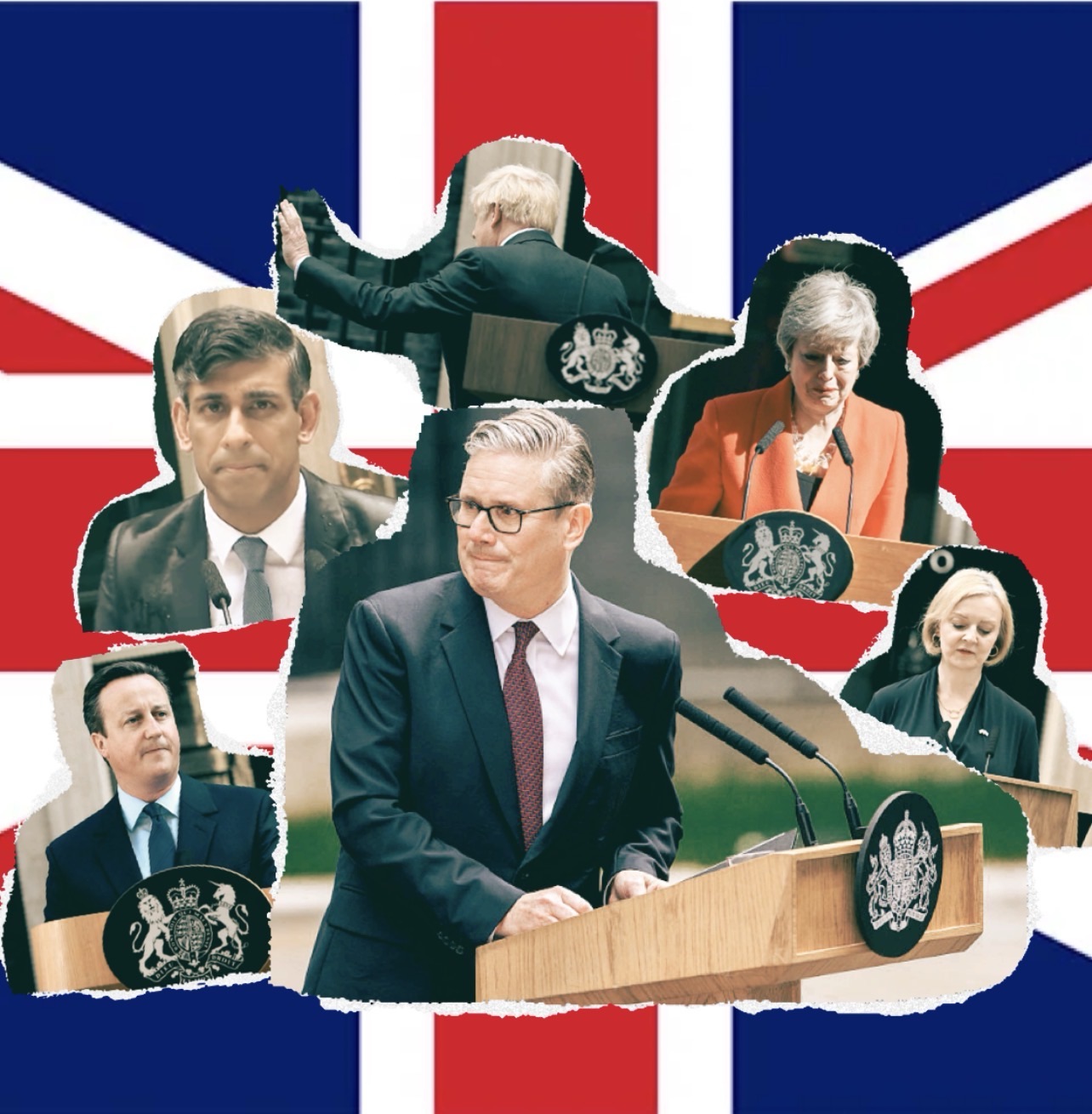
Keir Starmer has resigned as Leader of the Labour Party and Prime Minister of the United Kingdom. His resignation, following months of mounting pressure, declining poll numbers, and growing unrest within his own party, will trigger a Labour leadership election and bring Britain its seventh Prime Minister in the past ten years. It has not even been two years since Labour’s landslide victory over Rishi Sunak’s Conservative Party in the 2024 general election. That election was widely seen as a chance to restore stability after years of political turmoil, scandals and leadership changes under the Conservatives. Yet Starmer has now become the latest Prime Minister to leave office before completing a full term, continuing a pattern that many hoped had finally come to an end. How did this happen and what went wrong?

Image via: The i News
Tomorrow marks ten years since David Cameron announced his resignation following the Brexit referendum. Cameron, who had served as Prime Minister since 2010 and won a second term in 2015, campaigned for Britain to remain in the European Union. When voters instead chose to leave, he concluded that it was no longer appropriate for him to lead the country through the process. He lasted for six years. ¹
His successor, Theresa May, inherited the difficult task of delivering Brexit. However, repeated attempts to secure parliamentary approval for her withdrawal agreement ended in failure. After years of deadlock and division, May announced her resignation in 2019. She lasted for three years. ²
Boris Johnson entered Downing Street promising to “Get Brexit Done.” He secured a large majority in the 2019 general election and formally completed Britain’s departure from the European Union. However, his premiership became increasingly overshadowed by controversy, most notably the Partygate scandal, which centred on gatherings held in government buildings during COVID-19 restrictions. As he lost support from his cabinet, Johnson resigned in 2022. He lasted for three years. ³
Johnson was succeeded by Liz Truss, whose mini-budget sparked turmoil in financial markets, causing a sharp fall in the value of the pound and forcing a series of humiliating U-turns. She lasted 49 days, making her tenure the shortest in British history. ⁴
Rishi Sunak then became Prime Minister, tasked with restoring confidence in both the government and the Conservative Party. Despite stabilising the situation after the Truss crisis, Sunak struggled to escape the political damage caused by his predecessors. After serving for one year and eight months, he led his party into the 2024 general election, where Labour achieved a landslide victory and returned to power after fourteen years in opposition. ⁵

Image via: FE Week. Starmer following his victory.
For many voters, Labour’s victory was not just a change of government, but a chance to end Britain’s era of revolving-door prime ministers. After a decade of Brexit battles, leadership contests, scandals and political instability, there was hope that a large parliamentary majority would finally provide a period of long-term government.
But as we now know, this is not the case. One year and eleven months after a historic landslide victory that left the Conservatives at a historic low, Starmer was pressured into resigning from his job. This is shockingly short, as compared to the first Conservative Prime Minister this century, David Cameron, Starmer could not even finish a single term. When Sunak announced the general election in 2024, speakers outdid Downing Street blasted “Things Can Only Get Better,” described as the Labour anthem. People seemed optimistic to replace the Tory’s and welcome a new Labour government.
So how did Keir Starmer become one of the most unpopular leaders in modern British politics? The answer is complicated. While Labour won a landslide victory in 2024, it seemed that the election was as much a rejection of the Conservatives as it was an endorsement of Labour. After fourteen years of Conservative government, many voters simply wanted change. The immediate opposition was of course the most realistic choice for a change in government to become the reality. Starmer entered office with a large parliamentary majority, but without the personal popularity or clear political vision enjoyed by some previous prime ministers.

Image via: The Independant. Starmer visiting Southport.
Within weeks of taking office, Starmer faced his first major crisis: the Southport stabbings and the riots that followed across parts of the country. His handling of the unrest divided opinion, with supporters praising his firm response while critics argued that his government failed to address the concerns that had fuelled the disorder. ⁶ Starmer would later address the nation, saying that things will get worse before they get better. ⁷
Economic issues would continue to haunt Labour. During the election campaign many voters hoped that a change in government would improve living standards and ease the cost-of-living crisis. However, inflation, housing costs and pressure on public services remained major concerns. Labour’s decision to cut Winter Fuel Payments for many pensioners was controversial and damaged the government’s standing among older voters. ⁸
Further difficulties would follow. Farmer protests, controversy surrounding prison releases, disputes over taxation proposals, and debates over the government’s handling of grooming gang investigations all contributed to a growing sense that Labour was struggling to maintain public confidence. ⁹ ¹⁰ ¹¹ ¹² One of the most controversial decisions was the Chagos Islands agreement, under which Britain agreed to transfer sovereignty of the territory to Mauritius while retaining a long-term lease over the strategically important Diego Garcia military base. Supporters argued that the deal resolved a long-running international dispute and strengthened Britain’s standing abroad. Critics including U.S President Donald Trump, however, accused the government of surrendering British territory and raised concerns about Mauritius’ relationship with China. ¹³
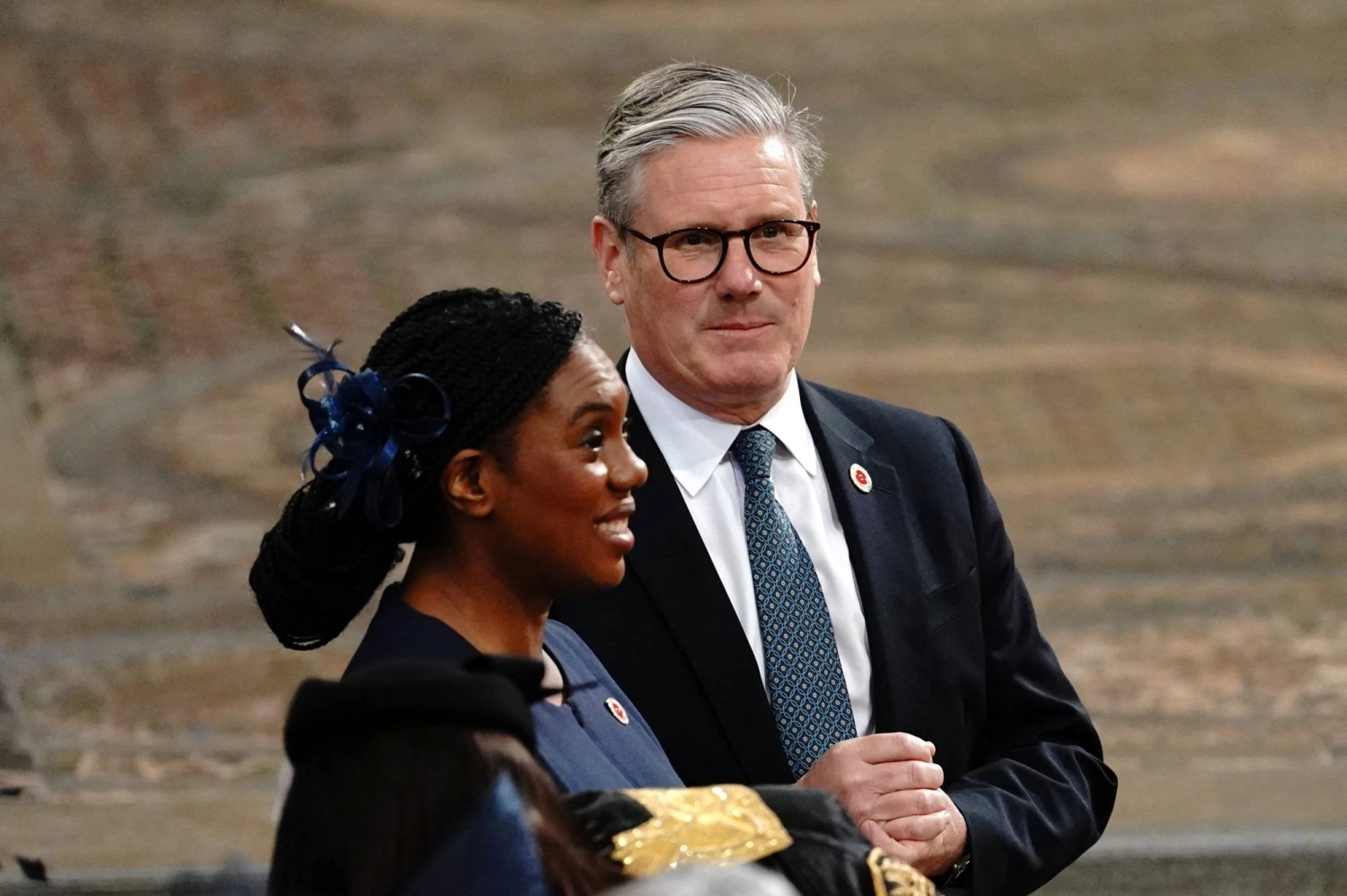
Image via: The Japan Times. Starmer with Kemi Badenoch, Leader of the Opposition.
Immigration and freedom of speech remained one of the most contentious issues. On his first day in office, Starmer scrapped the previous government’s Rwanda Plan. Critics argued that Labour lacked an effective alternative to tackle illegal migration. Following arrests connected to the 2024 riots and prosecutions for online activity, many commentators on the right began referring to Starmer as “Two-Tier Keir”, alleging unequal treatment by the justice system. ¹⁴
Supporters rejected the label, arguing that the government was simply enforcing existing laws. Nevertheless, the nickname became one of the defining criticisms of Starmer’s premiership. At the same time, Starmer faced opposition from the left. Pro-Palestinian activists criticised his government’s approach to the Gaza conflict, while others accused Labour of being too willing to restrict protest activity and make arrests towards what they call peaceful protestors, such as the Filton 25. ¹⁵ As a result, Starmer found himself attacked from both sides of the political spectrum.

Image via: CNA. Mandelson’s arrest in February.
Perhaps the most damaging of all was the Mandelson affair. In February this year, Starmer admitted that he had known Peter Mandelson had maintained contact with convicted sex offender Jeffrey Epstein, yet appointed Mandelson as Ambassador to the United States in 2025. After further revelations emerged and Mandelson became the subject of a police investigation, Starmer publicly apologised and said he regretted the appointment. The scandal triggered resignations within Downing Street, raised questions about Labour’s vetting procedures, and became a symbol for critics of what they saw as poor judgement at the heart of government. ¹⁶
Despite facing criticism over some foreign policy decisions, Starmer also received praise in several areas. He strongly supported NATO and continued Britain’s commitment to European security at a time of growing tensions with Russia. He also defended British troops and veterans who had served in Afghanistan after Donald Trump criticised NATO allies, claiming they had not done enough during the conflict. ¹⁷ ¹⁸ Starmer’s relationship with Trump was often described as complicated, with the two leaders cooperating on some issues while publicly disagreeing on others.

Image via: BBC
Starmer also surprised many observers by refusing to directly support the United States during its military strikes on Iran in 2025, despite pressure from both Washington and some domestic allies. ¹⁹ ²⁰ Supporters praised the decision as evidence of an independent foreign policy, while critics argued it risked damaging the “special” relationship between Britain and the United States.
Speaking of the Middle East, Starmer’s government made the historic decision to recognise the State of Palestine. The move was welcomed by many supporters who argued that it advanced the cause of a two-state solution in the Middle East. However, Israel criticised the decision and it further divided opinion over Britain’s role in the region. ²¹
The final months of his premiership were overshadowed by a series of controversies and Labour’s declining electoral performance. The party suffered disappointing results in local elections, struggled in Scotland, lost ground in Wales, and found itself increasingly challenged by Reform UK.

Image via: Global News. Starmer and Burnham.
Meanwhile, speculation is increasingly centred on Greater Manchester Mayor turned MP, Andy Burnham. Long regarded as one of Labour’s most recognisable politicians outside Westminster, Burnham has developed a reputation of an “independent-minded champion of northern England”. Relations between Burnham and Starmer became a talking point in February 2026 when Burnham was denied the chance to stand for Labour in the Runcorn and Helsby by-election. Some Labour members saw the move as an effort to prevent a possible rival from returning to Parliament. Burnham would later return to Westminster after winning a parliamentary seat in a subsequent by-election in June, further fuelling speculation about his leadership ambitions. ²²
As someone living in Japan, revolving-door prime ministers are not something new to me, or even particularly surprising. Before Shinzo Abe began his second premiership and went on to serve for eight years, Japan had seen six prime ministers who each served a year or less, including Abe’s own brief first term. Since Abe resigned in 2020, the country has already had four more prime ministers.
What surprises me about Britain is that even a change of government has not brought an end to the cycle. Starmer has now followed the same path as several of his predecessors, echoing the situation in Japan between 2009 and 2012, when three Democratic Party prime ministers each lasted a short amount of time. ²³
This raises a broader question: is it healthy to reject prime ministers so quickly? Between Thatcher’s rise to power in 1979 and Blair’s resignation in 2007, Britain had only three prime ministers. They faced controversies, crises and unpopular decisions, as any national leader inevitably does, yet neither their parties nor the public demanded their resignation with the same speed seen in recent years. In contrast, leaders such as Boris Johnson, Rishi Sunak and Keir Starmer faced intense pressure to leave office long before completing a full term.
This is not an argument in defence of any particular politician, but rather a question about the future of British politics itself. While removing unpopular leaders can be seen as a sign of accountability, constant leadership contests and changes at the top may also create instability, making it harder for governments to pursue long-term goals and maintain confidence at home and abroad. As Britain prepares to welcome its seventh prime minister in ten years, it is worth asking whether this has become the country’s new political normal, and whether that is a sustainable path for the United Kingdom on the world stage.
⁴ Euractiv
⁷ Sky News
¹⁰ BBC News
¹² Sky News
¹⁷ International Bar Association
¹⁸ CNN
¹⁹ The Guardian
²¹ The Times
²² BBC News


Leave a Reply