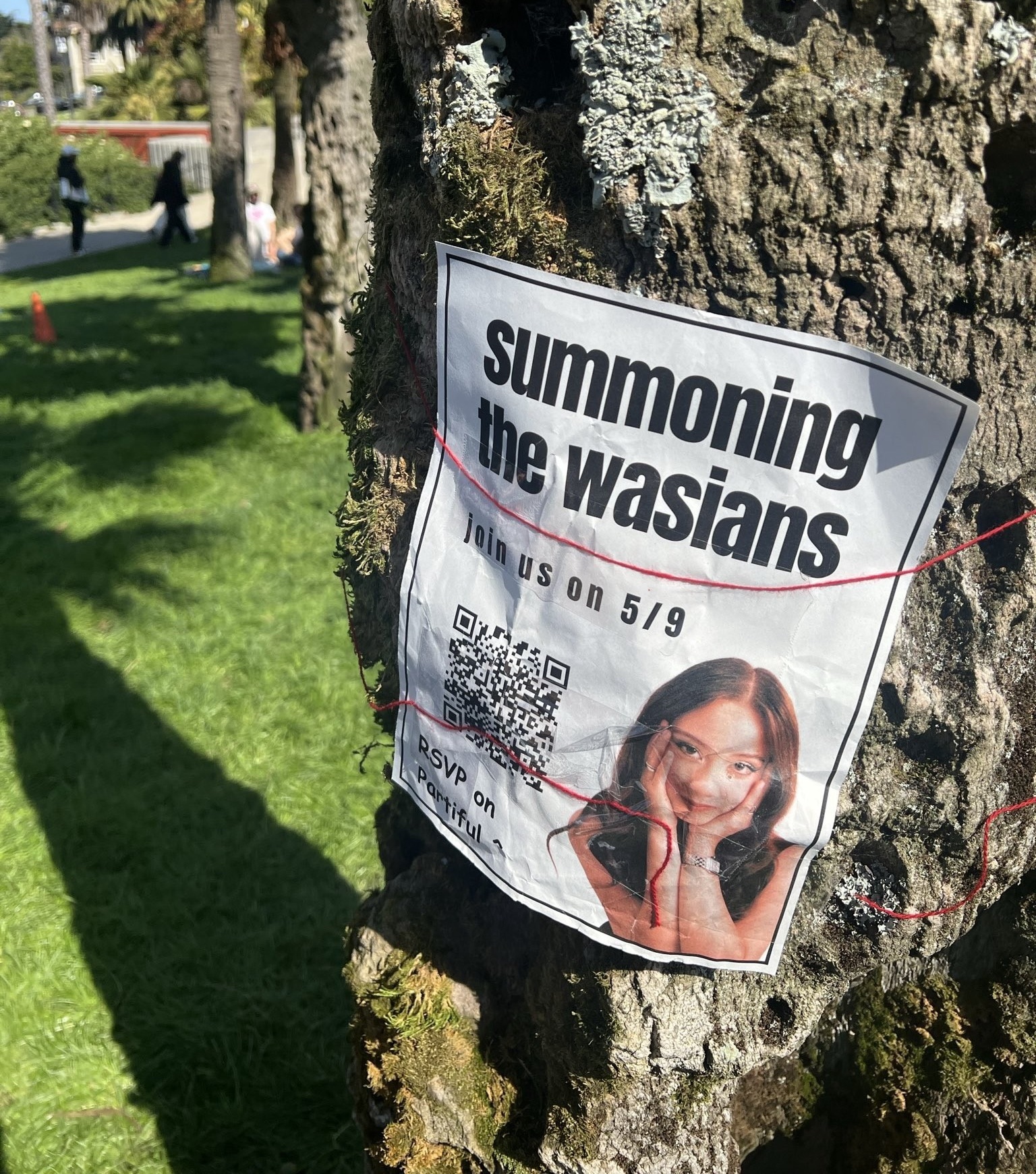
When clips of a large “Wasian Meetup” in the United States began circulating online, I already knew what the reaction would be before even opening the comments. Mockery, accusations of fetishisation, people questioning why mixed white-Asian people “need a community,” and endless jokes about “wasians always making their race their entire personality” and how “wasians want to feel oppressed so bad”.
If you spend enough time online, especially in spaces dominated by American discourse, you will quickly notice that white-Asian mixed people are often treated differently from other mixed-race groups. There is a tendency to treat them almost as an unserious minority: privileged enough to mock, but still “ethnic” enough to stereotype. That contradiction is what interested me most about both the meetup itself and the backlash surrounding it.
To be clear, I am not writing this as somebody who fully related to the event. In fact, many parts of it felt foreign to me despite technically sharing the same racial background as many attendees. I often describe myself as half English and half Japanese rather than “wasian,” and much of the online culture surrounding American mixed-race identity feels very distant from my own experiences. At the same time, I still found the reaction to the meetup disappointing, particularly the way many people immediately dismissed or ridiculed the idea of white-Asian people gathering together at all.
One detail from the meetup that stood out to me was the name tags attendees wore. Many identified themselves through labels such as “mum: Chinese, dad: White” or “mum: Japanese, dad: White.” I found this interesting because it reflects a specifically American way of viewing identity. The “white” side is often flattened into a broad racial category, while the Asian side is tied to a specific nationality or ethnicity. Personally, I would never introduce myself as “half white” first and foremost. I would say English and Japanese.
That distinction matters because it highlights the difference between race and cultural identity. In many American discussions around mixed-race identity, whiteness becomes treated as a singular category while Asian identities remain tied to nation, language, and heritage. As someone who spent most of my life in Japan and grew up directly connected to my Japanese side, the idea of identifying primarily through the word “wasian” feels strange to me. It feels more like an internet-era identity label than a meaningful cultural description.
Still, despite not strongly relating to the culture surrounding the meetup, I do not think there is anything inherently wrong with mixed white-Asian people creating spaces for themselves. Communities built around shared identity exist everywhere. There are Black Asian groups, South Asian diaspora communities, Eastern European communities and Japanese cultural associations overseas, and countless other spaces formed around shared experiences. Mixed-race people often struggle with feelings of not fully belonging to either side of their background, so naturally some seek out others who understand that feeling.
What frustrated me was how quickly many people online framed the gathering as inherently suspicious. Simply being a white-Asian mixed person openly discussing identity seemed enough for some commenters to accuse attendees of fetishism, racial superiority, or wanting to feel oppressed. There is an underlying assumption in some online spaces that relationships between the two are a result of white men fetishising Asian women, and Asian women degrading themselves with self-hatred, and that mixed children born from those relationships somehow represent that dynamic themselves. I find that way of thinking deeply unfair. Interracial relationships should not immediately be reduced to political symbolism or internet stereotypes simply because one parent is white and the other is Asian.
At the same time, I also understand why parts of the meetup made some people uncomfortable. Watching the clips myself, I sometimes felt that the event leaned too heavily into internet aesthetics and social-media culture. Certain videos felt more like influencer networking events than genuine cultural exchange. The heavy emphasis on the term “wasian” itself also contributed to that impression. There is definitely a strain of online mixed-race culture, especially in the United States, where identity can begin to feel performative or overly branded. Even as someone who is mixed white and Asian, I sometimes find myself rolling my eyes at content where “I’m wasian” becomes somebody’s entire online persona.
Some clips especially gave off that feeling. One video that widely circulated online showed attendees dramatically saying “welcome to Wasiaaaaa.” Watching that, my genuine reaction was simply: what? Moments like that made the event feel less like a meaningful discussion about identity and more like an internet subculture trying to turn itself into an aesthetic. But finding parts of the culture cringe-worthy is completely different from believing the people involved deserve mockery or should not be taken seriously.
One thing I found particularly revealing was how comfortable many people seemed making jokes or stereotypes about white-Asian people that would be considered unacceptable toward other minorities. Comments mocking white fathers and Asian mothers, reducing mixed children to “fetish babies,” or treating white-Asian identity as inherently artificial were incredibly common. Ironically, many of these comments came from people who otherwise present themselves as progressive, left-leaning or anti-racist.
This is where I think the discussion becomes inconsistent. Although I do not personally use the term “people of colour,” white-Asian people are generally included within it. Yet they are often excluded from empathy the moment conversations around discrimination, stereotyping, or identity struggles arise. Because white-Asian people are perceived as closer to whiteness, their experiences with racism or exclusion are frequently treated as less serious, less legitimate, or even comedic online.
That does not mean white-Asian people experience racism in the same way as every other group. Different communities obviously face different histories and realities. However, the constant jokes about “wanting oppression,” the dismissal of identity struggles, and the reduction of mixed-race people into memes all contribute to an atmosphere where trivialising white-Asian identity feels socially acceptable when it should not be.
At the same time, I also understand why parts of the meetup made some people uncomfortable. Watching the clips myself, I sometimes felt that the event leaned too heavily into social-media aesthetics. Certain videos felt more like influencer networking events than genuine cultural exchange. The heavy emphasis on the term “wasian” itself also contributed to that impression. There is definitely a strain of online mixed-race culture, especially in the United States, where identity can begin to feel performative or overly branded.
That narrowing reflects another issue I noticed throughout the discourse: the tendency for American racial conversations to divide mixed people into increasingly specific categories. “Wasian,” “Blasian,” and countless other labels become treated almost like separate social groups. Personally, I struggle to relate to that mindset. While mixed people obviously have different experiences depending on their backgrounds, I ultimately see mixed-race people as sharing many overlapping experiences rather than existing in completely separate identity camps.
This is also why the entire discussion felt very “American” to me. The idea of referring to one side simply as “white” while identifying the other through nationality reflects a uniquely American racial framework. White-Asians are also not only based in the United States or the West; many live in Asian countries themselves or elsewhere entirely, often with very different relationships to identity, language, and belonging. In the United States, however, mixed-race identity itself often becomes heavily categorised and subdivided in ways that can feel foreign to those outside that environment.
This is why I found both the meetup and the backlash fascinating. The meetup itself sometimes felt overly online, commercialised, and disconnected from how I personally understand my own identity. Yet the backlash often revealed something equally uncomfortable: a willingness to dismiss white-Asian people as shallow, attention-seeking, or racially illegitimate in ways that many would never tolerate toward other mixed or minority groups.
Actor Quentin Nguyen-Duy argued in an interview with CNN that some fascination with “wasians” is connected to colourism and Eurocentric beauty standards. I think that conversation is worth having seriously. ¹ If someone genuinely believes their proximity to whiteness makes them superior or more attractive, that absolutely deserves criticism. But it is irresponsible to automatically assume those motivations exist simply because mixed white-Asian people gathered together publicly.
Ultimately, my feelings on the entire situation are mixed. I did not strongly identify with the meetup itself, nor with the highly Americanised internet culture surrounding it. However, I also believe the backlash exposed how selectively empathy is applied in online conversations about race. Mixed-race people should be able to form communities, discuss identity, and even be awkward or cringe online without immediately becoming targets of ridicule or suspicion. You do not have to relate to the “Wasian Meetup” to recognise that.
¹ CNN

Leave a Reply