
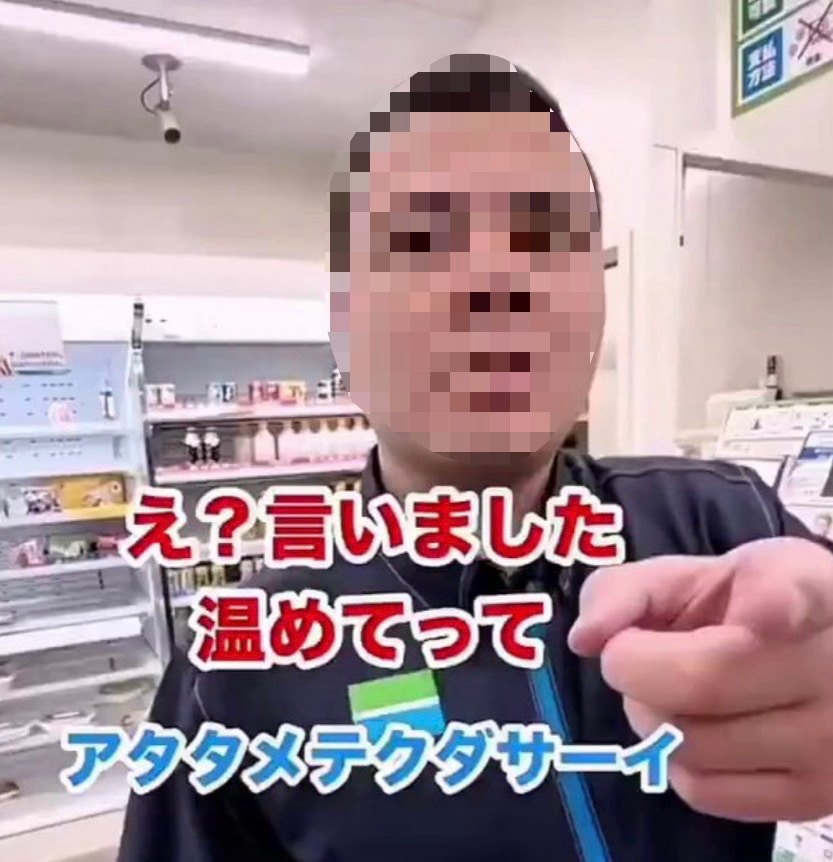
A viral video has been circulating across Japanese social media showing a FamilyMart employee, apparently of foreign origin, engaged in a heated confrontation with a customer who is filming him.
The video begins with the employee, whose name tag does not appear to be Japanese, speaking in fragmented Japanese. He seems to be objecting to the customer’s use of informal language, insisting that he should use more polite Japanese when making requests. Referring to a request to heat up a product, the employee appears to say that the customer should have said “please warm this up” rather than using a more casual expression.
The customer responds with visible confusion, asking what the employee is talking about and attempting to make sense of his limited Japanese. The situation quickly escalates. The employee, whose face is now visible in the video, slams his hands on the counter, leaves the register area, and directly confronts the customer while pointing at him and raising his voice. The clip ends shortly afterwards, providing viewers with only a brief glimpse of the interaction, and no information about what occurred beforehand or after wards whatsoever.
This article does not serve as an attempt to defend the actions shown in the video. Rather, it is an examination of how easily a brief clip, stripped of context and explanation, can shape public opinion. I would like to explore how individual incidents can quickly become representative of entire groups in the public imagination. A disagreement between two people can, within hours, be transformed into a discussion about foreigners, immigration, culture, or national identity. In doing so, a single moment is often asked to carry far more meaning than it was ever capable of providing.
To start off, let’s address the worker’s actions. Whether you’re Japanese or not, most people would agree that slamming your hands on the counter, aggressively confronting a customer and pointing at them is not acceptable behaviour for convenience store staff. One detail worth noting is the employee’s use of the word “omae” towards the customer. To non-Japanese readers, this may seem insignificant, as the word is often translated simply as “you”. In Japanese, however, “omae” carries a much rougher tone. Used by a convenience store employee towards a customer, it would be considered remarkably impolite and helps explain why many Japanese viewers reacted so strongly to the clip. Japan in particular places a huge emphasis on customer service, professionalism, and keeping your emotions under control in public-facing jobs. Even if a customer is being difficult, most people would expect an employee to remain calm. Workers are taught about Japanese etiquette, such as bowing and using formal Japanese.
I would also like to highlight a difference in customer-service expectations across cultures. Naturally, this varies from workplace to workplace, and it would be wrong to suggest that every shop in Japan or every shop overseas operates in exactly the same way. However, having lived in the UK in the past, I have witnessed situations in which customer-service workers responded firmly to aggressive or confrontational customers. In some cases, employees were willing to answer back, challenge inappropriate behaviour, or make it clear that a particular attitude was not welcome. Professionalism is still of course expected, but there is often less expectation that workers simply endure abuse without responding.
It is also worth noting that the customer’s original wording was hardly extraordinary. Saying “atatamete” (heat this up) rather than atatamete kudasai (please heat this up) is less polite, but it is something convenience store workers hear countless times every day. While many employees would undoubtedly prefer customers to be more polite, most would simply let it pass without comment. In that sense, many Japanese viewers were understandably puzzled by the employee’s reaction.
At the same time, the incident also reflects something broader about customer-service expectations in Japan. Customer-facing staff are generally expected to remain polite and composed even when dealing with difficult, unreasonable, or openly hostile customers, unless the situation escalates into something genuinely threatening. Maintaining professionalism in the face of confrontation is often seen as part of the job itself, even when the customer is being less than polite.
I know this from personal experience. Having worked in customer service in Japan, I have had to calmly deal with and apologise to customers whose anger seemed disproportionate to the situation, or who appeared to be directing their frustrations at staff members simply because they could. Whether one agrees with these expectations or not, they help explain why many Japanese viewers reacted so strongly to the employee’s behaviour in the viral clip.
This is important because many Japanese viewers were not simply reacting to the employee’s anger. They were reacting to a perceived violation of what a customer service worker is expected to be. Seen through that lens, the employee’s behaviour appears even more striking than it might to viewers from countries where workers are afforded greater freedom to challenge rude customers.
That said, recognising Japan’s customer-service expectations does not necessarily mean those expectations should be beyond criticism. In recent years, Japan has begun paying greater attention to issues such as customer harassment, with some companies introducing policies designed to better protect employees from abusive behaviour. This suggests that the traditional relationship between customers and service workers is already being reconsidered.
However, even if one believes these expectations should change, this particular incident is unlikely to be the model for how that change occurs. A worker openly confronting a customer in anger is very different from establishing clearer boundaries regarding acceptable behaviour. The two should not be confused.
The incident has led to wider discussions about whether this worker, and foreign workers in Japan more broadly, are able to adapt to or integrate with Japanese working: culture. Many people have pointed out that if someone cannot accept the norms of customer service in Japan, it may be difficult for them to continue working in such environments. On that point, I can somewhat understand the argument. There are clear expectations in Japan aboutn how customer-facing staffare expected to behave, whether one agrees with them or not.
What I do not agree with, however, is the use of a short, contextless video as a basis to promote an anti-foreigner or anti-immigrant narrative. A one-minute clip with no clear explanation of what was said or done beforehand is not enough to generalise about an entire group of people. Yet that is exactly how this has been used by some online users as supposed “proof” of a wider claim.
What I have personally seen, in contrast, is many migrant workers in convenience stores in Japan making genuine efforts to speak Japanese politely and serve customers respectfully, including bowing and following the expected etiquette. It is not fair to group all foreign workers together as if they are inherently aggressive or incompatible with Japanese society.
I will not name or show the worker’s face out of respect for his privacy. Unfortunately, his name is now widely available online, which is a shame given how little verified information we actually have about what led up to the incident. Why did the customer begin recording? Was there already tension before the camera started rolling? How long had the interaction been going on before filming began? These are the kinds of unanswered questions that remain after watching the clip. And while it is important not to automatically villainise the worker, it is equally important not to villainise the customer without this missing context. We also do not have a full record of what was actually said by the customer to begin with, or how it was said, beyond what appears in the clip itself.
If this worker chooses to continue working in Japan, he would need to understand the expected do’s and don’ts of customer service, whether he personally agrees with them or not. Slamming a counter in front of a customer is something that should never happen in any service context. At the same time, it is important to recognise that the clip we saw is not enough to justify the kind of sweeping conclusions that were drawn from it. What we are often reacting to online is a story we have already filled in for ourselves, rather than the real incident.




Leave a Reply