
Almost three years have passed since the Noto Peninsula Earthquake struck Ishikawa Prefecture on New Year’s Day 2024. At 4:10 PM, while many people across Japan were spending the first afternoon of the year visiting shrines and welcoming the new year, a magnitude 7.6 earthquake devastated communities across the peninsula.
According to Ishikawa Prefecture, the disaster caused 732 deaths, and damaged more than 116,000 residential buildings. But the earthquake was not the last disaster Noto would face. On September 20, 2024, torrential rain brought further destruction, flooding communities already struggling to recover. The subsequent flooding killed 16 people in Ishikawa Prefecture, damaged homes and agricultural land, and disrupted reconstruction efforts.
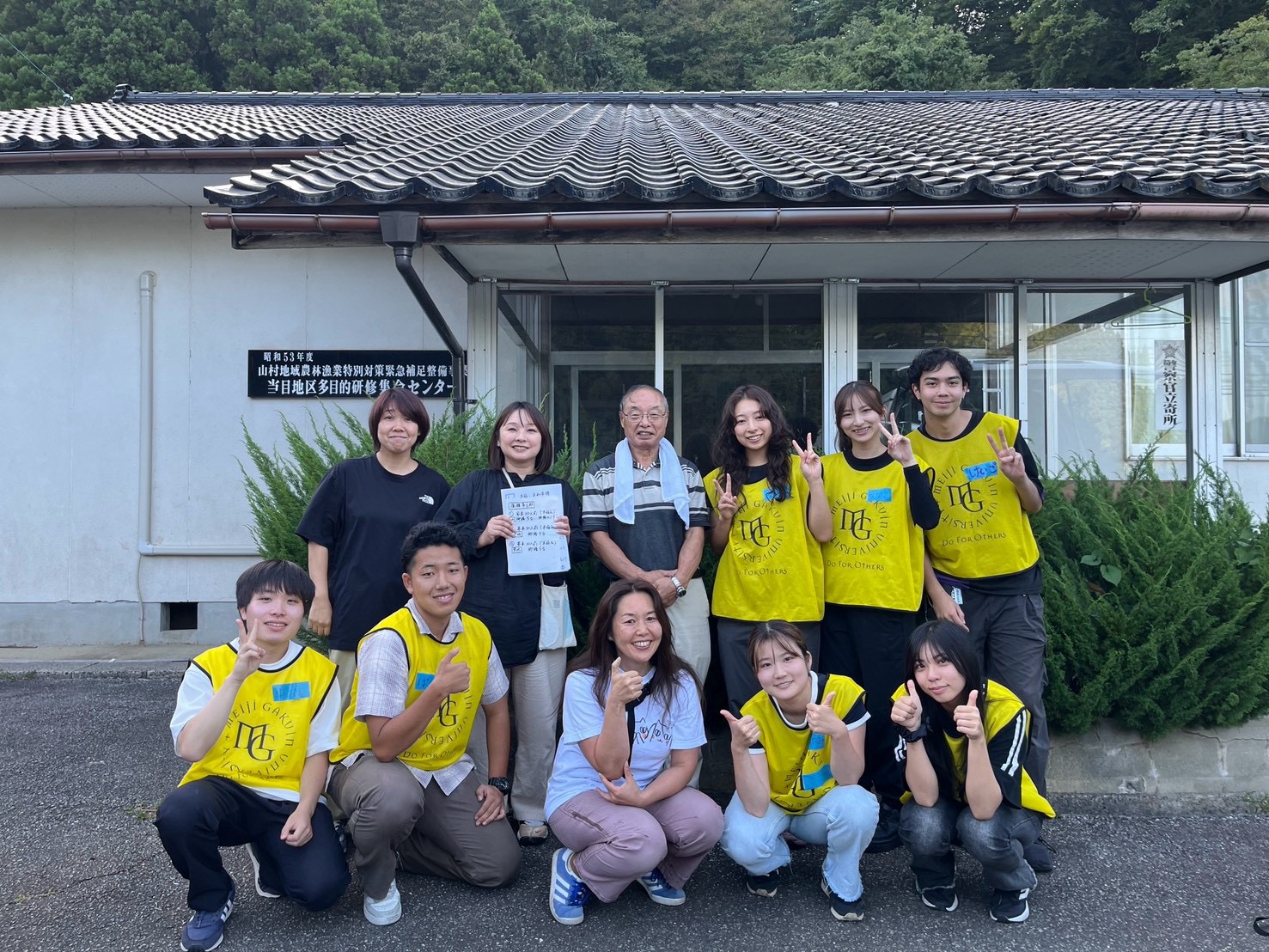
In September 2026, I travelled to Noto for five days as part of a Meiji Gakuin University and Public Interest Foundation for Community Development volunteer programme. I had heard about the earthquake, of course, but like many people living outside the region, I had gradually stopped hearing about what was happening there. Noto had slipped out of the headlines, at least from my perspective.
For many people, Noto may now be remembered simply as somewhere in Japan where a major earthquake happened a few years ago. For people abroad especially, it may be difficult to place Noto on a map, let alone know much about the area or how its communities have been getting on since. I wanted to understand what life there looked like now, beyond the images of collapsed buildings that had circulated in the immediate aftermath. What I found was a place with a strong sense of community, a rich cultural history and people determined to preserve their hometowns, despite the difficulties facing them.

Our first destination was Wajima, one of the main cities on the Noto Peninsula. Coming from the Kanto region, I found it considerably more rural than I had expected. Meeting some of the local people who would accompany us during our stay, we took a walk through the city.
I was unsure what to expect. I had not followed the recovery particularly closely, and I realised how little I actually knew about the present condition of the area. Aside from a bent utility pole, the roads seemed almost normal to an outsider like me, as though nothing had happened.
One sight that stayed with me was a large white torii gate at a local Shinto shrine. Its upper crossbeam was missing, leaving the familiar shape visibly incomplete. I did not take a photograph out of respect, so I have included an image taken from the cited source above. I am not particularly religious, but seeing a recognisable religious symbol damaged in this way felt strangely unsettling; it felt like blasphemy, and simply something that did not look right. The torii had already collapsed in the 2007 Noto Peninsula Earthquake before being rebuilt in 2020 with seismic reinforcement. Yet the 2024 earthquake tore its foundations from the ground, causing it to collapse once again. Witnessing a place of worship in this state left an impact on me, making the scale of the disaster feel more tangible.
That afternoon, we visited Attacafe, a community space established in January 2025 where children and local residents can gather. It works alongside other organisations in the area, including Wajima Teen Lab, providing a place for children to spend time together. We prepared snacks and played with the children after school. They also showed us how to make origami, which turned out to be rather more challenging than I expected. Throughout the afternoon, I found myself thinking about the earthquake. Was I supposed to feel sorry for these children? Was it appropriate to simply enjoy myself while knowing what their community had experienced? I eventually realised that I was looking at the situation from the wrong perspective. These children were not spending every afternoon thinking about the earthquake. They were playing, laughing, making things and enjoying time with their friends. They deserved to have a space where they could simply be children.

One moment in particular caught my attention. I heard someone behind me repeatedly asking, “Gaikoku? Gaikoku?,” essentially asking whether I was a foreigner. When I turned around, a boy told me he was half Italian. He then introduced me to a friend who was half Chinese, and another who was half Filipino. As someone who is mixed Japanese myself, seeing all of these childreen with the same roots as me was quite heartwarming. We did not have a particularly long conversation, but I wondered whether seeing an older person with a similar background might have meant something to them. Growing up mixed-race in Japan can sometimes feel like navigating between different worlds. If my presence made that experience feel a little more ordinary, even briefly, I was glad. I hadn’t expected to meet other mixed-heritage children, particularly in a relatively rural part of Ishikawa like Noto. I later found out that one of the boys had remarked to himself after speaking with me, “His Japanese is so good,” which I found to be quite charming.
The following day, we travelled to Tome, a rural settlement in the mountainous interior of Noto. The difference between here and Wajima was immediately apparent.

The landscape was surrounded by mountains, with rice fields following the narrow valleys. We spent time cooking local dishes, including zenmai (bracken shoots), alongside residents who introduced us to the area’s food and traditions.
We shared the meal sitting together around a traditional low dining arrangement, with red lacquerware bowls and a particularly tall serving vessel at the end of the table. It was a welcoming experience, and the food provided an opportunity to learn about the region through something as everyday as eating together.

One local woman, after hearing that I had visited several countries, told me that she had never left Japan, let alone Ishikawa Prefecture. I found this fascinating. Having grown up in the Kanto region, travelling between neighbouring prefectures has always felt ordinary to me, so the idea of never having left a single prefecture was something I hadn’t really considered. It made me realise how differently people experience the world, and how much of everyday life can be shaped by the place where you grow up and the connections you build there.
After we ate, Katsuyoshi Shuden, a local NPO representative, explain what happened in the immediate aftermath of the earthquake. By September 2026, the physical signs of the disaster were not always obvious. Roads had been repaired, some buildings had been cleared, and everyday activities had resumed. Hearing a first-hand account, however, brought the events of January 2024 much closer.
He showed us photographs taken in the days following the earthquake. Roads had split open, sections of mountainside had collapsed, and enormous rocks had fallen onto routes connecting the settlements. Some roads were reduced to a single passable lane, with the possibility of further rocks falling from above. In some places, residents had to take lengthy detours simply to reach neighbouring communities. He also described how the local evacuation centre had been organised. The designated public shelter was difficult to reach because the roads had been damaged, so residents initially gathered at a smaller local meeting place instead. Food and essential supplies had to be collected from a larger distribution centre and transported back to the settlement through a system coordinated by local representatives.
For some residents, the initial evacuation period lasted months. People who could eventually return home did so, while others moved into secondary evacuation facilities or temporary housing.
What left an impact on me most was how much of the response depended on people in the community organising themselves, particularly in an area with an ageing population. The photographs made the earthquake feel less like a single event that happened on New Year’s Day and more like a series of difficulties that continued long after the shaking stopped. I could not see all of those immediate effects around me anymore, but the people sitting beside me had lived through them. Their experiences were not distant history.

We also visited a local shrine where numerous kiriko were being stored. Kiriko are enormous illuminated wooden floats used in Noto’s traditional summer festivals. Some stand several metres tall and are carried through local streets as part of celebrations that have been passed down through generations.
The shrine’s doors had been damaged by the earthquake, and the kiriko stood inside, gathering dust and cob-webs, without the usual festival atmosphere. Seeing these impressive structures sitting motionless in the building was a rather sad sight. The earthquake and subsequent population decline have made it increasingly difficult for some communities to hold their festivals. Damaged roads, displaced residents and a shortage of people available to carry the floats have all contributed to cancellations and scaled-down celebrations.
For a community, losing a festival also means losing an occasion for residents to come together, connect different generations and celebrate an important part of their local identity.

Another activity involved cleaning Wajima-nuri, the region’s renowned traditional lacquerware. Wajima-nuri is known for its durability and elaborate production process, involving multiple layers of lacquer and careful craftsmanship.
We washed the individual pieces with sponges, rinsed them in approximately 40-degree water and wiped them twice. Afterwards, we sorted the lacquerware according to markings on their undersides, allowing pieces belonging to the same owners to be returned to their respective boxes. I recall being struck by how beautiful the rows of bright red bowls and other objects looked.
What we managed to clean was only a fraction of what remained, however. Many more pieces still needed attention. It made me think about what it means to preserve a culture. Wajima-nuri has long been part of everyday family life in the region. These objects have been used at meals, cared for over the years and passed between generations. Cleaning them felt like a small contribution to preserving those family connections and keeping the tradition alive.

Whilst we were sat near the rice fields, inhaling the fresh countryside air, Mr. Shuden explained that the settlement had historically relied on rice cultivation and the use of surrounding mountain resources, including charcoal production. However, the earthquake and subsequent flooding had severely damaged its agricultural land.
The geography made recovery particularly difficult. Rice fields in this mountainous area are arranged in narrow terraces along valleys rather than large, flat expanses. When the earthquake triggered landslides, the subsequent flooding carried soil and debris into these valleys, burying fields and making it difficult to predict when cultivation could resume.
For the older residents, this was not only meant losing an income, as farming had been part of their lives for generations, providing a sense of purpose as well as a livelihood. Being unable to continue working their land had taken an emotional toll.
Mr. Shuden also spoke about a problem that existed long before the earthquake: depopulation. Younger generations have increasingly moved towards larger cities in search of education and employment, leaving behind communities with an ageing population. The disasters have accelerated this process, with some residents leaving after being displaced from their homes.

The figures reflect the scale of the problem. Between January 2024 and September 2025, the combined population of Wajima, Suzu, Noto and Anamizu fell by approximately 12%. The decline among residents aged 39 and younger was particularly pronounced. For rural settlements, fewer residents mean fewer people available to maintain rice fields, manage forests, organise festivals and keep community spaces running. The earthquake and flooding have made an already difficult situation more complicated.
What I found most compelling was the local representative’s vision for the settlement’s future. Mr. Shuden spoke about finding ways to keep the community viable for future generations, while adapting to the challenges it faces. One idea involved attracting people from outside the region to visit, spend time there and develop connections with local residents. He spoke about preparing traditional houses as places where visitors could stay, eat and experience life in the countryside. He also discussed finding ways to make rice cultivation viable for younger people, including taking over fields that older farmers could no longer manage.
Mr. Shuden described his approach as thinking not about what cannot be done, but about what needs to be done and how to make it possible. Rather than expecting people to relocate permanently straight away, he wanted to create opportunities for people to visit, understand the area and gradually develop a relationship with it. He also made an important point about the value of local knowledge. Things that residents might consider ordinary, such as traditional farming methods or regional food, can be unfamiliar and fascinating to people visiting from elsewhere. Sometimes, an outsider’s interest can help a community recognise the value of things it has taken for granted.
It made me reconsider what regional preservation actually involves. Keeping a place alive is not only about restoring buildings or repairing roads. It also means finding reasons for people to remain, return and become involved.

Returning to Wajima after spending time in the much more remote rural settlement of Tome, the city felt surprisingly urban to me. I had initially thought of Wajima as a very rural place myself, but the contrast with Tome gave me a different perspective. We then visited temporary housing provided for people whose homes had been destroyed or rendered uninhabitable. From the outside, the housing looked relatively modern and well maintained. However, we were also able to see some of the limitations of the living arrangements.
The available space was restricted, making it difficult for families to have sufficient privacy. We were also told about the uncertainty surrounding future housing arrangements. Even where residents could eventually move into longer-term housing, the transition could involve another move, creating further disruption after an already difficult period. It was a reminder that providing someone with a roof over their head does not necessarily mean that their previous life has been restored.

Another destination was the travelling Wajima Morning Market, known as Shucchō Wajima Asaichi. Before the earthquake, the market was held along a traditional street in the city centre. However, the earthquake caused severe damage to the area, including a major fire, making the original location unusable. The market now operates from a temporary location within the city, at Wajima Waiwai Plaza. The orange tents and flags give the market a distinctive appearance. The colour has become a recognisable part of its identity, bringing to mind the colourful stalls and lively atmosphere of the original Asaichi.
The market has a history stretching back more than a thousand years. Its vendors traditionally sold seafood, vegetables, dried goods, flowers and local crafts, with many stalls run by women. Seeing the market continue in a different location was a reminder that although its original setting had been lost, the people and traditions behind it remained.

Over the course of our five-day stay, two words repeatedly came up in conversations with local residents: fukkyū (復旧) and fukkō (復興). The former refers to restoring what was damaged, while the latter is about rebuilding and revitalising a community for the future. The distinction is important. Repairing roads, houses and infrastructure is one thing. Creating a place where people can once again build their lives, maintain their livelihoods and imagine a future is another.
For communities such as those in Noto, the two processes are closely connected, but they are not necessarily happening at the same pace.

After five days, I found myself reflecting on how my understanding of Noto had changed. I had arrived expecting to see the visible aftermath of a major earthquake. Instead, I found that some of the most significant challenges were not immediately visible. A repaired road does not tell you whether the surrounding rice fields can be cultivated again. A newly built house does not necessarily mean a family has regained the stability it once had. A traditional festival cannot continue simply because its floats have survived.
The people I met were not defined by the disaster, nor were they waiting for someone from outside to tell them what to do. They had their own ideas, ambitions and plans for their communities. What they often needed was more people to take an interest, visit, listen and understand what makes their region worth preserving.

I do not think five days is enough to understand everything Noto is going through, let alone claim to have made a significant difference. But I came away with a much greater appreciation of the region and the people who call it home. Perhaps the most important thing I took away was that supporting a place does not have to end when the immediate disaster response is over. Continuing to visit, taking an interest in local culture and sharing the stories of its communities can also help maintain connections between Noto and the wider world.
Noto is more than the location of a devastating earthquake. It is a place with its own traditions, landscapes, food and people, all of which deserve to be known in their own right.
Writing about Noto has also given me another opportunity to share something about the region through my work as a writer. An article I wrote for Metropolis Japan about Aenokoto, a traditional winter ritual in which rice-farming households welcome and entertain the deity of their rice fields, is scheduled to appear in the magazine’s winter issue next month.
Metropolis is a free English-language magazine distributed at various locations around Tokyo. You can find its distribution locations through its Pick Up a Copy page.


Leave a Reply