
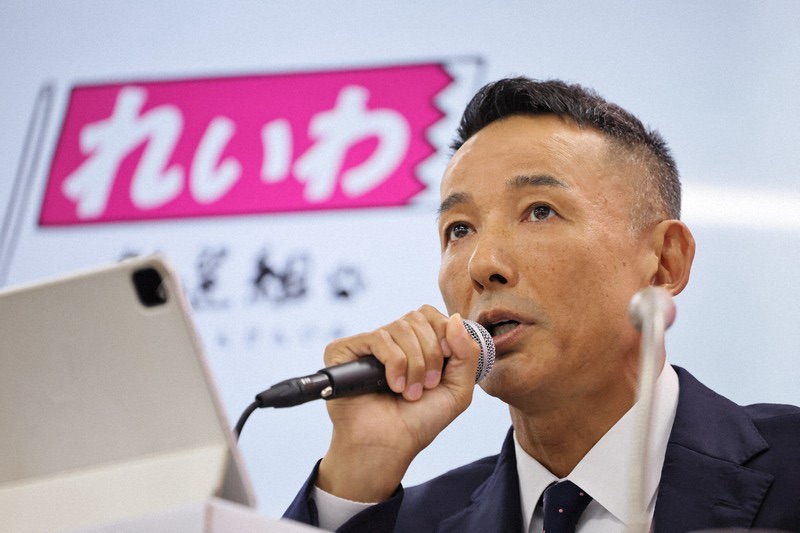
Photo: Mainichi Shinbun
Taro Yamamoto, the founder and long-serving leader of the left-wing populist political party Reiwa Shinsengumi, has announced his resignation from both the party leadership and politics following a speeding offence. He announced that the party would change its name after a new leader is elected, effectively bringing the party he founded to an end in its current form. His departure marks the end of a political movement that many described as being closely associated with his own personality and activism. 1
Yamamoto first gained his spotlight as an actor, appearing in numerous television dramas and films, most notably the 2000 cult classic Battle Royale. Following the 2011 Great East Japan Earthquake and the Fukushima nuclear disaster, he became increasingly involved in anti-nuclear activism. 2 In 2013, he was elected to the House of Councillors as an independent, starting a political career that would see him become one of Japan’s most recognisable opposition politicians.
In 2012, Yamamoto joined the Liberal Party, a small opposition party led by Ichiro Ozawa. During its existence, the party sought to unite various anti-LDP forces and, for a period, even adopted the name “People’s Life Party & Taro Yamamoto and Friends,” highlighting the extent to which Yamamoto had become the party’s most recognisable and central public figure. 3 The Liberal Party dissolved in 2019 after merging into the Democratic Party for the People, prompting Yamamoto to establish his own political movement.

Photo: Saitama Shinbun
Later that year, he founded Reiwa Shinsengumi, serving as its first and only leader. The party’s name combines Reiwa, Japan’s current imperial era which began in 2019, with Shinsengumi, the famous samurai police force that defended the Tokugawa shogunate during the final years of the Edo period.
Under Yamamoto’s leadership, Reiwa Shinsengumi positioned itself as a left-wing populist party advocating for expansive welfare policies, wealth redistribution, higher taxes on large corporations and the wealthy, stronger protections for workers, opposition to nuclear power, and constitutional pacifism. The party also campaigned for increased support for people with disabilities, greater assistance for low-income households, reductions in the consumption tax, and a more generous social security system. Throughout its existence, Reiwa sought to appeal to voters who felt overlooked by Japan’s traditional political establishment. 4
Although on the smaller side of Japan’s main national parties, Reiwa Shinsengumi attracted great attention through Yamamoto’s outspoken campaigning style and unconventional political tactics. The party made gains in several national elections and became known for promoting candidates from underrepresented backgrounds, including individuals with severe disabilities. 5
Yamamoto had resigned from the House of Councillors in January after being diagnosed with multiple myeloma, a form of blood cancer. At the time, he announced that he would continue serving as party leader while reducing his workload to focus on treatment. 6
However, on the 9th of July 2026, Yamamoto announced his resignation as leader of Reiwa Shinsengumi after being found to have committed a speeding offence in October 2025. He later confirmed that he would retire from politics and that his party would adopt a new name. 1 Given that Reiwa Shinsengumi was founded by Yamamoto and remained under his leadership from its establishment in 2019 until 2026, the announcement came as a significant development in Japanese politics. The party’s identity, messaging, and public image had become closely intertwined with Yamamoto’s personality and political style, making it difficult to separate the movement from its founder. As a result, his departure represents an end of an era for the party itself.

The episode also reflects Japan’s broader political culture regarding public accountability. While speeding is a relatively minor offence compared with corruption scandals that have occurred elsewhere in the world, Japanese politicians are often expected to accept personal responsibility for misconduct. Although legal punishment should apply equally regardless of status, the expectation that public officials step down after breaking the law remains significantly stronger in Japan than in many other democracies. Yamamoto’s resignation not just as party leader but from politics as a whole, and the subsequent redesign of the party he founded, illustrates how political responsibility in Japan often extends beyond legal consequences to encompass public trust and personal accountability. The case highlights Japan’s strong culture of political accountability, where maintaining public trust is considered just as important as the legal consequences of an offence.





Leave a Reply