
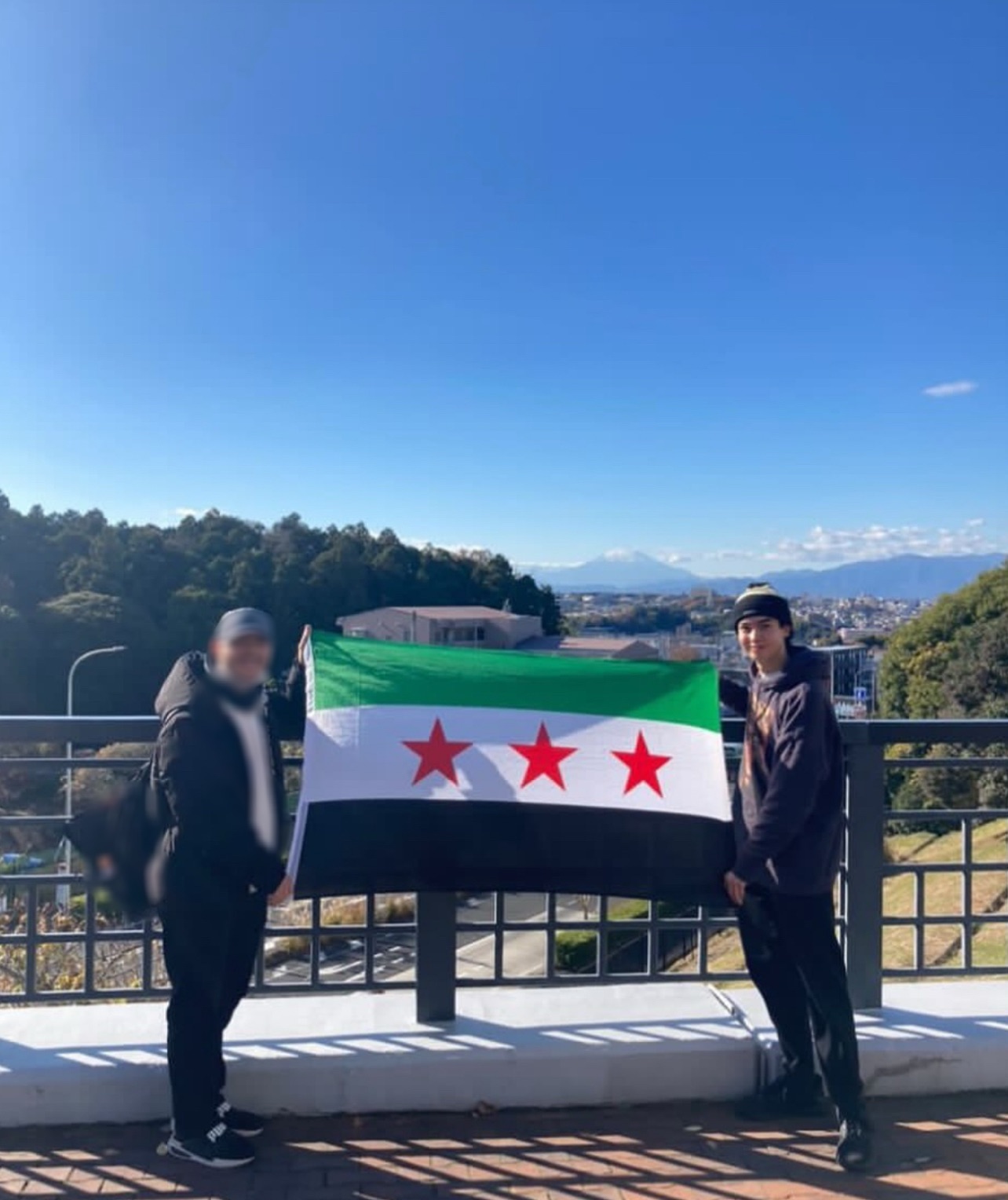
When I first saw the news of the toppling of the Assad regime on December 7, 2024, I was taken by surprise. I was curious to know what this may mean for the future of Syria. That same year, I had met my first Syrian friend, who shared much about his culture with me. I knew very little about Syria, and hearing how he had settled in Japan after fleeing the war, uncertain when he might next see his family, was something that I could hardly imagine. When I read the headlines, I hoped this could be a step toward my friend one day returning to his homeland. The next day, he bought the Syrian opposition flag, which later became the new national flag of Syria, to our university campus. Upon conversing with him, I learnt that whilst he now had somewhat of an idea of when he could return to his country, the formal end of the Syrian civil war and the government change did not explicitly mean all was “back to normal” for the citizens of Syria.
Syria is a diverse country with people of various faiths and ethnicities living together. Sunni Muslims are the majority, followed by Shia sects such as the Alawites, while Christians, Druze and Yazidis make up smaller communities.¹ This diversity has shaped Syrian society for centuries, and it also plays a key role in the country’s politics, as different groups have historically held varying levels of power and influence in the country.2 For example, with the Assad family themselves being Alawite, a minority sect within Islam, members of the Alawite community became closely associated with the state and military. This is a legacy that has contributed to heightened tensions and vulnerability following the collapse of the regime.3
For many outside Syria, the fall of the Assad regime may have appeared to mark a clear end to the conflict. Images of celebration and headlines announcing a new government gave the impression that Syria was heading towards a brighter 2025 and future. However, the reality on the ground has been far more complex.
Despite the Civil War that lasted 14 years coming to an end, Syria today still faces many problems. Clashes triggered by conflict between pro-Assad loyalists and the new government’s forces led to killings of Alawite civilians in March.4 Described by some media outlets as “revenge killings”, reports attributed the attacks to Syrian Armed Forces, government-aligned fighters, and members of extremist groups.5 According to reports, the new President Ahmed al-Sharaa denied any involvement in the attacks, and he condemned them.6 After all, these killings stand in contrast to al-Sharaa’s goal in uniting Syria without excluding any ethnic or religious minorities.7
Syria remains shaped by the presence of multiple armed actors and overlapping conflicts. ISIS has carried out renewed attacks in recent months, including bombing a church in June, attacking Syrian and U.S. troops in December, and bombing an Alawite majority mosque on Boxing Day, a few days ago as I write this.8 At the same time, Syria faces instability from a Kurdish insurgency in the north, Israeli military activity in the south, and localised clashes involving Druze and Bedouin armed groups.9 Overall, these tensions highlight how Syria’s post-Assad landscape remains uncertain, rather than unified under a single conflict or resolution.
Despite these ongoing challenges, progress has been made. Ahmed al-Sharaa has been signalling to Western governments that Syria under his leadership is more willing to cooperate with them on the global stage, particularly on shared security concerns such as ISIS. He has expressed this through his presence at the United Nations General Assembly and the Oval Office alongside President Trump, the former marking the first by a Syrian leader in almost 60 years, and the latter in almost 80 years.10

On the 7th of December, 2025, one year on from the toppling of the Assad regime, I joined my friend in an event at Tokyo Camii, the largest mosque in Japan. They were hosting an event marking Syria’s new chapter. The Syrian diaspora, Japanese guests and other visitors came together to celebrate. I was surprised to learn just how many Syrians live in Japan; Arab News reported in July this year that the population was 1,594.11 I had no idea there were this many here, and seeing them all come together at Tokyo Camii made the scale of the community and their resilience feel even more real.

We arrived early to volunteer to help set the place up. I arranged tables, prepared the food, and inflated white, green, and red balloons. I spoke with many attendees, both Muslim and Christian Syrians, all coming together to celebrate. As I ate the delicious Syrian food laid out, as many attendees wore the new national flag around their shoulders as they danced and sang in Arabic. I was also invited to join in.
While the atmosphere was joyful, it was impossible to forget the immense suffering Syrians had endured during the 14 year war, including attacks on civilians, chemical weapons, and the displacement of millions. I felt both honoured and humbled to witness this resilience and cultural pride firsthand.

¹ “Syria,” Minority Rights Group International
3 Charles River Editors, Syria and the Assad Family: The History Behind Bashar al-Assad’s Rise to Power and the Civil War (Charles River Editors, 2013), pp. 3–4.
4 Syrians describe terror as Alawite families killed in their homes, BBC News
5 The New Humanitarian, “Alawites caught between revenge and a new Syria,” 26 March 2025.
6 Al Jazeera, “Syria forms committee to investigate coastal violence outbreak,” 9 March 2025.
8 “Mourners gather in Syrian city of Homs for victims of deadly mosque bombing,” PBS NewsHour.
9 “Israel reportedly targets Bedouin convoy in Syria after attacks,” Al Jazeera, 18 July 2025.




Leave a Reply